
Sponsored by


Curated foreign policy and national security news for professionals.
Good morning,
Welcome back to another Monday morning edition of The Intel Brief. Let’s begin.
Reporting Period: March 12-16, 2026
Bottom-Line Up Front:
1. On March 15, US forces struck Iran’s Kharg Island. President Trump stated the key oil infrastructure on the island was not targeted, a gesture of goodwill to incentivize the reopening of the Strait of Hormuz. Additionally, the Tripoli ARG was redeployed from Japan to the Middle East, indicating conventional operations will continue or expand in the long-term.
2. This week, reporting showed how the US is using AI-integrated systems to improve warfighting and border security operations. At the border, DHS is continuing to deploy RAST surveillance systems. For the US military, Palantir’s Maven system has been employed, greatly improving the US “Kill Chain.”
3. European governments and energy authorities are preparing to support a historic coordinated release of strategic oil reserves to stabilize global energy markets disrupted by the ongoing war involving Iran and threats to shipping through the Strait of Hormuz. The US also plans to announce a naval coalition to escort vessels through the Strait of Hormuz.
US, Israel Continue Operation Epic Fury In Iran
Summary
On March 15, US forces struck Iran’s Kharg Island. President Trump stated the key oil infrastructure on the island was not targeted, a gesture of goodwill to incentivize the reopening of the Strait of Hormuz. Additionally, the Tripoli ARG was redeployed from Japan to the Middle East, indicating conventional operations will continue or expand in the long-term.

Findings and Analysis
Background: Last week, Iran named Ali Khamenei’s son, Mojtaba, as the new Supreme Leader (The Intel Brief). Despite the appointment, Mojtaba has not made a public appearance or statement, suggesting that reports of him being injured in strikes is true (The Intel Brief). Additionally, on March 11, President Trump stated that the operation could end soon due to the success of US and Israeli strikes (The Intel Brief).

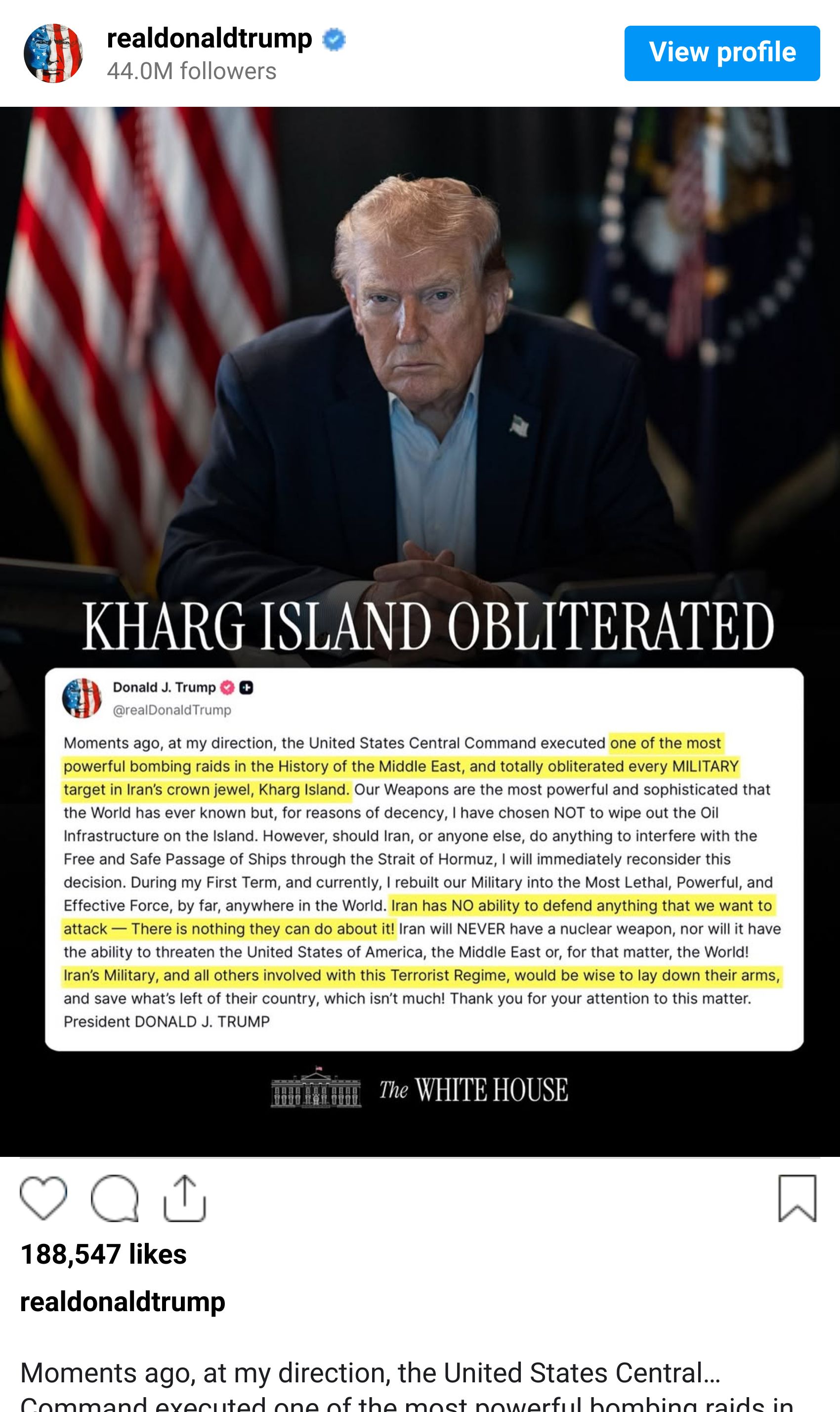
Continued Operations: On March 15, President Trump confirmed that US Central Command conducted strikes on Kharg Island (DOW). President Trump confirmed that he ordered the strikes, but refrained from destroying the oil infrastructure on the island (DOW). Trump’s statement suggests he preserved the oil infrastructure in order to incentivize the opening of the Strait of Hormuz (DOW).
On March 13, it was announced that the Tripoli Amphibious Ready Group is deploying to the Middle East from Japan (Marine Corps Times). The group includes upwards of 5,000 personnel and several warships, including the 31st Marine Expeditionary Group (MEU) (Marine Corps Times).
Comment: Even if Operation Epic Fury does end, or is paused, there is no indication that Iran would engage in diplomacy or de-escalation. Last week, some reporting claims Iran has attempted to activate “Sleeper Cells,” in addition to the IRGC splitting into nearly 30 commands to better coordinate unconventional military responses (The Intel Brief). Additionally, the US Department of State’s Diplomatic Security Service is currently offering $10 million for information related to IRGC leaders, indicating that US strikes will continue in the long-term (Fox KTVU). This is further supported by Trump’s claims that the US will need to arm and mobilize the Iranian people to pressure regime change (Fox News).
Strategic Risk: According to Financial Times, the US has burned through “years” of munitions stockpiles in just two weeks of strikes associated with Operation Epic Fury (The Kobeissi Letter).
Comment: While the US has spent billions of dollars worth of munitions, we have also lost tens of billions worth of aircraft and radar facilities. Additionally, the redeployment of assets from the Pacific, such as the 31st MEU, risks leaving the Indo-Pacific theater ill-prepared to respond to an escalation or conflict with China.
US Adopting AI-Assisted Systems For Border Security, Improved Kill Chain
Summary
This week, reporting showed how the US is using AI-integrated systems to improve warfighting and border security operations. At the border, DHS is continuing to deploy RAST surveillance systems. For the US military, Palantir’s Maven system has been employed, greatly improving the US “Kill Chain.”
Findings and Analysis
Maven Smart System: On March 12, representatives from Palantir praised the performance of the capabilities of the Maven Smart System during Operation Epic Fury (The Register). Palantir claims the system, enabled by AI, allows for target identification, weaponeering, and engagement from one system as opposed to multiple with human decision-makers (The Register). The system is being praised for enhancing the US “Kill Chain,” the “third offset” of operation speed and accuracy in military decision-making that gives the US a superior edge (The Register).

GDIT AI Towers: On March 11, Defense One reported that GDIT will install 148 Relocatable Autonomous Surveillance Towers to the US border this year, along with 50 of its next-generation models (Defense One).

Relocatable Autonomous Surveillance Towers (RAST): The RAST utilizes long-range cameras, “electro-optical sensors, radar, and… LIDAR” to conduct image recognition and coordinate asset responses in an expedited manner (Defense One, GDIT).
Europe Preparing To Release Oil Reserves Amid Middle East Conflict, Strait Of Hormuz Closure
Summary
European governments and energy authorities are preparing to support a historic coordinated release of strategic oil reserves to stabilize global energy markets disrupted by the ongoing war involving Iran and threats to shipping through the Strait of Hormuz. The US also plans to announce a naval coalition to escort vessels through the Strait of Hormuz.
Findings and Analysis
Historic Oil Reserve Release: The European Union is reportedly preparing to release 400 million barrels of oil from emergency stockpiles which are held by members of the International Energy Agency (EBC, Politico). If executed, the drawdown would represent the largest emergency oil release in history, exceeding the coordinated reserve release conducted after Russia’s invasion of Ukraine in 2022 (EBC).
European Commission’s Progress: On March 13, the European Commission convened a meeting of the European Union’s Oil Coordination Group and Gas Coordination Group to assess the bloc’s supply chain (EU, Politico). Despite orchestrating the plans to release strategic reserves, the EU working groups reportedly stated that no short-term supply chain shortages are expected, and that oil stock levels are likely to remain high as disruptions continue (EU).
Comment: The longer the Strait of Hormuz remains closed, or dangerous to transit, the more likely it is that the global oil supply will dwindle due to less product reaching markets. With this consideration in mind, the longer the Strait remains closed, the more likely it is that the EU will expand its naval escort mission in the region. Which is influenced by this next development:
Escort Coalition: On March 15, The Wall Street Journal reported that President Trump will announce plans for a multinational coalition that will escort vessels through the Strait of Hormuz, despire Iran’s mining and closure of the waterway (WSJ). The Wall Street Journal stated that the White House did not provide a timeline for this mission's start, nor a list of coalition members (WSJ). The report comes as the US Navy reportedly declined to offer escorts due to mission priorities and inherent risk (Maritime Executive).
Currently, the EU is conducting Operation Aspides, which protects and escorts vessels in the Red Sea and Gulf of Aden (The Intel Brief).
Comment: While not a sign of guaranteed long-term operations, committing to escorting vessels through the Strait of Hormuz does imply that a persistent threat level will remain in the region due to sustained hostilities. Sustained hostilities are almost certain to lead to more volatile energy markets and increased costs.
What Will Your Retirement Look Like?

Retirement looks different for everyone. What it costs, where the income comes from, how long it needs to last. Those answers are specific to you.
The Definitive Guide to Retirement Income helps investors with $1,000,000 or more work through the questions that matter and build a plan around the answers.
Download your free guide to start turning a savings number into an actual retirement income strategy.
End Brief
That concludes this brief.
Thank you for reading!
— Nick
This publication is an Open-Source Intelligence (OSINT) product and does not contain Controlled Unclassified Information (CUI) or Classified Information.
Comments represent the analysis, opinions, and estimates of The Intel Brief writer(s).