In partnership with


Curated foreign policy and national security news for professionals.
Good morning,
This is the Thursday Morning edition of The Intel Brief. Let’s begin.
Reporting Period: March 9-12, 2026
Bottom-Line Up Front:
1. Iran has appointed Mojtaba Khamenei as its new Supreme Leader. Operation Epic Fury has led to destroying most of Iran’s military infrastructure, reducing its ballistic missile arsenal by roughly 90%, and enabling air superiority after more than 5,500 strikes. Despite losses, Iranian leadership is reportedly preparing retaliatory measures, including the activation of overseas sleeper cells and mining in the Strait of Hormuz. While President Trump has suggested the conflict could end soon, the shift toward unconventional retaliation raises the risk that the war could continue in a more unconventional form.
2. On March 11, G7 leaders held an emergency meeting to address global energy market disruptions caused by the ongoing conflict with Iran. Discussions focused on a potential coordinated release of strategic oil reserves and measures to secure maritime trade routes in the Persian Gulf.
Iran Selects New Supreme Leader, Plans Retaliatory Strikes As Operation Epic Fury Continues
Summary
Iran has appointed Mojtaba Khamenei as its new Supreme Leader. Operation Epic Fury has led to destroying most of Iran’s military infrastructure, reducing its ballistic missile arsenal by roughly 90%, and enabling air superiority after more than 5,500 strikes. Despite losses, Iranian leadership is reportedly preparing retaliatory measures, including the activation of overseas sleeper cells and mining in the Strait of Hormuz. While President Trump has suggested the conflict could end soon, the shift toward unconventional retaliation raises the risk that the war could continue in a more unconventional form.
Findings and Analysis
Operation Epic Fury Progress: On March 11, President Trump suggested that the war with Iran could end soon due to the volume of successful strikes by US and Israeli forces (The Kobeissi Letter). On March 11, the White House stated that Iran’s ballistic missile arsenal has been reduced by 90%, with over 5,500 targets being struck (The White House). The same report claims the US has established air superiority over Iran, which allows for freedom of operations (The White House). An infographic, provided by US Central Command, confirms these details.

Comment: As the US’s conventional military targets are destroyed, and strategic objectives are achieved, the likelihood of the conflict ending increases. However, as US strikes continue to succeed in reducing Iran’s capabilities and pressuring the remaining decision-making body, regime change objectives evolve. Likewise, the longer the conflict goes on, the more likely Iran is to commit to an unconventional and protracted defense. At this stage, if the US does not establish and pursue regime change objectives, Operation Epic Fury could be ordered to end, with US and Iranian relations remaining hostile, with no nuclear deal being reached. This state of affairs would leave room for future operations to continue.
Iranian Supreme Leader: On March 9, Iran named Mojtaba (the son of Ali Khamenei) as the new Supreme Leader (Ground News, Reuters). Ground News reports that the 88-member Assembly of Experts convened to select and confirm Mojtaba (Ground News).
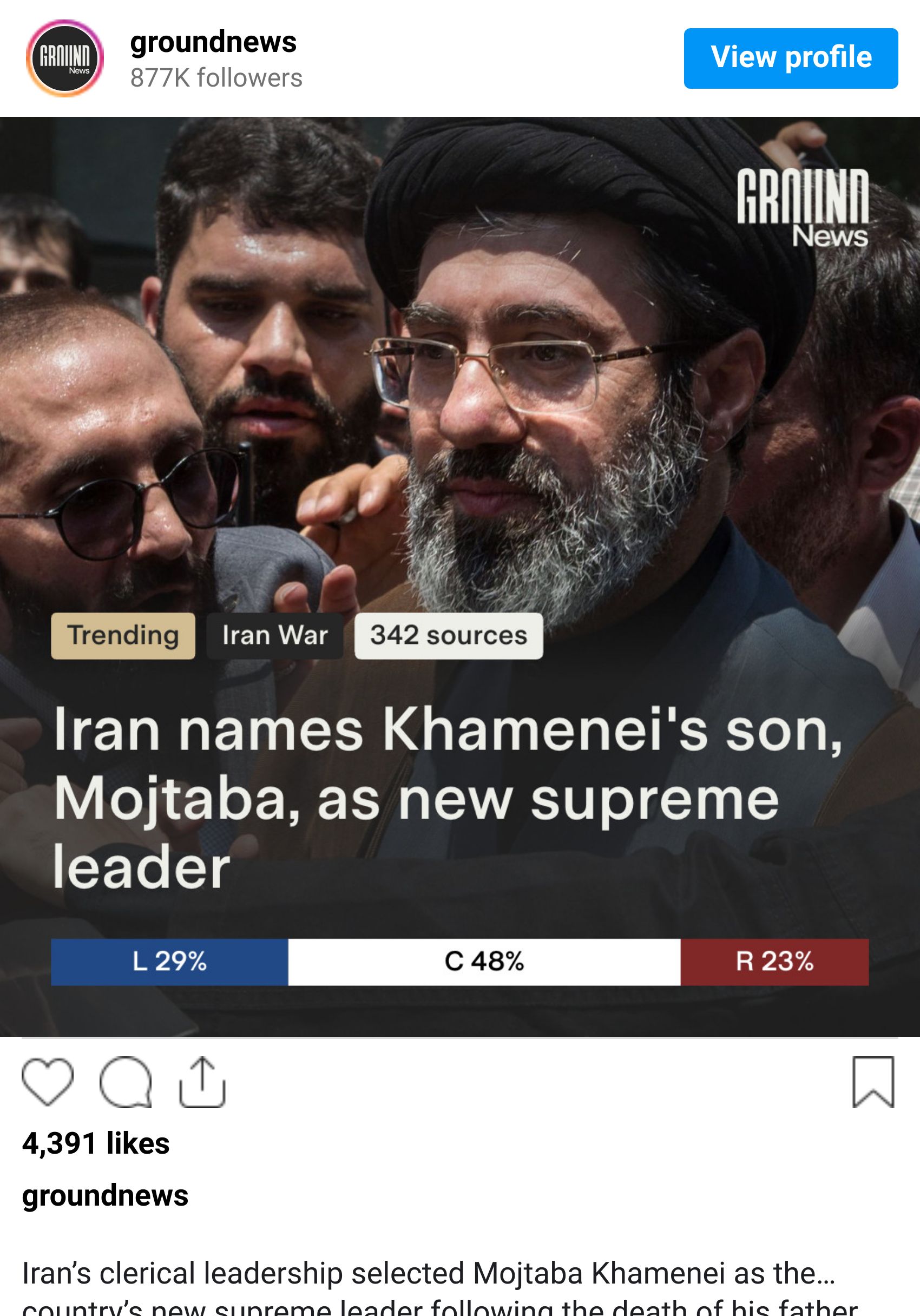
Comment: Supreme Leader Mojtaba has not been seen in public since his appointment to Supreme Leader. Early speculation suggested that Mojtaba was killed or injured in previous strikes, and was chosen to invoke the image and legacy of Ali Khamenei. However, Reuters reports that Mojtaba is alive and “lightly injured” (Reuters). Regardless of the status of Mojtaba’s health and his ability to govern Iran and coordinate a response, President Trump stated that if the new Supreme Leader is not approved by his administration, “he’s not going to last long” (Ground News).
Iran’s Unconventional Response Capabilities: On March 9, ABC News reported that US intelligence personnel intercepted Iranian communications believed to be “an operational trigger” for sleeper cells (ABC News). While details are reportedly being uncovered and analyzed, the report states that “preliminary signals analysis” was relayed across multiple countries, and likely contained instructions for “covert operations” (ABC News). In addition to the possibility of sleeper cell activities, Iran has reportedly begun laying mines in the Strait of Hormuz, which poses a threat to military and civilian vessels transiting the region (The Kobeissi Letter).
Finally, Israel and the Lebanese president are reportedly engaged in talks to end the conflict with Hezbollah due to the success of strikes, suggesting Iran’s terrorist proxy network is significantly degraded (BBC).
Comment: It is uncertain, if Iranian sleeper cells exist abroad, where they are operating or when they may conduct hybrid operations or retaliatory strikes. However, US policymakers, law enforcement, and DHS officials should consider this a serious and growing threat. In 2025, a similar warning was issued after Supreme Leader Khamenei threatened to activate “sleeper cells” in the West (New York Post). Likewise, the FBI had reportedly alerted law enforcement that Iran desires to launch drone strikes on California from offshore vessels (The Hill). Finally, consider that as the war continues, and Iran’s conventional capabilities continue to be degraded, the likelihood of unconventional retaliation increases.
G7 Convenes To Address Looming Energy Crisis, Oil Trade
Summary
On March 11, G7 leaders held an emergency meeting to address global energy market disruptions caused by the ongoing conflict with Iran. Discussions focused on a potential coordinated release of strategic oil reserves and measures to secure maritime trade routes in the Persian Gulf.
Findings and Analysis
Emergency Session: On March 11, French President Macron hosted a virtual emergency G7 session to discuss the disruptions to global energy markets in lieu of ongoing operations in Iran (Reuters, Canadian Government). Attendees reportedly discussed releasing 300 to 400 million barrels of oil from national stockpiles, as well as the possibility of establishing a coalition to escort merchant vessels in the Gulf region (CNBC, Al Arabiya English).
Comment: Reaching a decision on re-securing oil trade is critical, especially for Europe. While the decision would be intended to stabilize markets in the short-term, the decision is also to avoid a long-term energy crisis and to reduce the chances of energy shortages in Europe by the start of winter. For context, with a shift from goal and nuclear energy on the continent, Europe is heavily dependent on energy imports, with 60% of energy sources coming from abroad.
How Jennifer Aniston’s LolaVie brand grew sales 40% with CTV ads

For its first CTV campaign, Jennifer Aniston’s DTC haircare brand LolaVie had a few non-negotiables. The campaign had to be simple. It had to demonstrate measurable impact. And it had to be full-funnel.
LolaVie used Roku Ads Manager to test and optimize creatives — reaching millions of potential customers at all stages of their purchase journeys. Roku Ads Manager helped the brand convey LolaVie’s playful voice while helping drive omnichannel sales across both ecommerce and retail touchpoints.
The campaign included an Action Ad overlay that let viewers shop directly from their TVs by clicking OK on their Roku remote. This guided them to the website to buy LolaVie products.
Discover how Roku Ads Manager helped LolaVie drive big sales and customer growth with self-serve TV ads.
The DTC beauty category is crowded. To break through, Jennifer Aniston’s brand LolaVie, worked with Roku Ads Manager to easily set up, test, and optimize CTV ad creatives. The campaign helped drive a big lift in sales and customer growth, helping LolaVie break through in the crowded beauty category.
End Brief
That concludes this brief.
Thank you for reading!
— Nick
This publication is an Open-Source Intelligence (OSINT) product and does not contain Controlled Unclassified Information (CUI) or Classified Information.
Comments represent the analysis, opinions, and estimates of The Intel Brief writer(s).