

Curated foreign policy and national security news for professionals.
Good morning,
Welcome to another mid-week briefing.
Reporting Period: February 16-19, 2026
Bottom-Line Up Front:
1. The third round of trilateral Ukraine peace talks concluded in Switzerland. While Russia and the US have suggested that talks are progressing towards a peace solution, Ukraine has stated that Russia continues to use diplomacy to drag out the peace process.
2. The second round of nuclear negotiations between the US and Iran has concluded in Switzerland. Iran, despite hostile rhetoric, has stated that progress has been made, and that a draft agreement is being made. Both Israel and the US have kept military strike options on the table, with some sources claiming a protracted conflict is imminent.
3. The EU has approved sixteen loans under the SAFE Instrument. The loans will provide EU member states with funds for defense procurement initiatives. Only three nations continue to wait for approval.
Ukraine Makes Battlefield Gains As Peace Negotiations Continue In Geneva
Summary
The third round of trilateral Ukraine peace talks concluded in Switzerland. While Russia and the US have suggested that talks are progressing towards a peace solution, Ukraine has stated that Russia continues to use diplomacy to drag out the peace process.
Findings and Analysis
Third Round of Peace Talks: On February 17 and 18, US-led trilateral talks convened in Geneva, Switzerland (The Intel Brief). As the war in Ukraine approaches its fifth year, President Zelenskyy stated that no agreement has been reached (The Guardian). Zelenskyy has accused Russia of continuing to use negotiations as a means of distraction and coercion, and that Moscow is “trying to drag out” the peace process while it attempts to make battlefield gains (The Guardian).
Russia’s lead negotiator, Vladimir Medinsky, stated that while the talks were “difficult but businesslike,” a new round of talks is already being coordinated (The Guardian).
ISW assesses that Russia will not offer concessions or compromise to end the war (ISW).

Background: On January 23, 2026, the first trilateral peace talks since 2022 convened. On February 5, trilateral talks between the US, Ukraine, and Russia continued in the United Arab Emirates, serving as the basis for the progression of ceasefire negotiations, a peace framework, and post-war diplomacy (The Intel Brief).
Comment: President Zelenskyy stated that oversight of the Zaporizhzhia nuclear powerplant, and the fate of Russia-occupied territories were the most contentious areas of talks (The Guardian). So while Russia may indeed be attempting to extend talks, Ukraine’s insistence on retaining territory it no longer controls is unlikely to be accepted by Moscow. This is an indication of irreconcilable differences. A clever tactic by Russia would be to agree to a ceasefire so Zelenskyy would be pressured to organize elections. That would be the highest chance of a pro-Russian or war-weary leader taking office; one willing to cede territory for long-term peace terms.
US-Russia Diplomacy: On February 17, an article by The Economist reports that Russia has offered the United States various economic deals and partnerships worth $12 trillion (The Economist). The offers reportedly include US access to Russia’s Arctic oil and gas, rare-earth mining opportunities, data centers supported by Russian nuclear energy, and a tunnel under the Bering Strait (The Economist, Tessaron). The offers, reportedly made during Putin’s August 2025 visit to Alaska, are consistent with rhetoric by one of Russia’s lead envoys (The Intel Brief).
Comment: Russia’s offers to the United States reflect its desire to engage with continental and global partners once a peace deal is reached in Ukraine. This could mean Russia’s return (or at least its desire to return) to the G8 and G20. Trump’s openness to cooperation with Russia, while unsavory, is political realism blended with the primacy of American foreign policy interests. It could be part of a long-term bid to partner with Russia, open it up economically and democratically, and outlive Putin’s oligarchy. It could also be that Trump and his admin, losing grace and alignment with Europe, are entertaining Russian cooperation to introduce urgency in rebuilding (or redefining) the relationships that form the Western world.
Battlefield Updates: Research by ISW reports that Russian forces have continued large-scale strikes on Ukrainian energy infrastructure (ISW). The same report claims Russia has planned such strikes, with intentional limitation, to pressure Ukraine and appease President Trump’s desire for restraint and eventual peace (ISW).
Despite Eastern Ukraine being Russia’s “main effort,” Ukrainian forces have recovered more than 200 square kilometers since February 13, the most significant territorial gain in two years (ISW, Visegrad24).

Comment: Ukraine’s battlefield strategy still remains the same: Defensively, minimize Russia’s territorial gains and reduce its ability to make negotiation demands based on battlefield conditions. Offensively, Ukraine continues to strike Russian military and energy infrastructure in an effort to reduce Russian revenue streams and increase the cost of sustained conflict.
Iran Negotiations Progressing Despite Military Buildup, Hostile Rhetoric
Summary
The second round of nuclear negotiations between the US and Iran has concluded in Switzerland. Iran, despite hostile rhetoric, has stated that progress has been made, and that a draft agreement is being made. Both Israel and the US have kept military strike options on the table, with some sources claiming a protracted conflict is imminent.
Findings and Analysis
Nuclear Negotiations: On February 17, 2026, a second round of nuclear negotiations took place between American and Iranian diplomats (Al Jazeera). The negotiations took place in Geneva, Switzerland (Al Jazeera). Iran’s top diplomat, Foreign Minister Abbas Araghchi, stated that “good progress” had been made on “guiding principles” which will make the beginning text of “a potential agreement” (Al Jazeera).
Araghchi stated that the draft agreement will be written and exchanged and that a date and location for the third round of negotiations will be organized (Al Jazeera).
Comment: The news of draft agreement being organized should be taken with some caution. Vice President Vance, in an interview with Fox News, stated that there are still “some red lines that the Iranians are not yet willing to actually acknowledge and work through,” indicating that military intervention is still possible (Fox News). Likewise, other reporting suggests that a protracted conflict between the United States, Israel, and Iran is “imminent” (The Kobeissi Letter).
Regional US Military Disposition: The US has continued to deploy military assets to the region in response to nuclear negotiations, continued conflict in Gaza, mass protests in Iran, and Iran shutting down the Strait of Hormuz (AP News, CNBC, CNN). The US force now consists of two aircraft carriers, twelve warships, and “hundreds” of strike-capable aircraft (The Kobeissi Letter).
Iranian Counteractions: On February 17, AP News reported that Iran has temporarily shut down the Strait of Hormuz for a live-fire exercise (AP News). The exercise, a display intended to boost deterrence, has temporarily halted one of the world’s busiest trade routes of which 20% of the global oil supply transits (AP News). On Tuesday, Supreme Leader Khamenei stated that while US warships pose a significant military threat, the “more dangerous” weapon is what “can send that warship to the bottom of the sea,” implying Iran may strike US Navy assets in the region (The Hill).
European Finance Ministers Approve Sixteen Defense Loans Part Of EU SAFE Instrument
Summary
The EU has approved sixteen loans under the SAFE Instrument. The loans will provide EU member states with funds for defense procurement initiatives. Only three nations continue to wait for approval.
Findings and Analysis
SAFE Instrument: In May 2025, the European Union’s Security Action for Europe (SAFE) instrument was adopted by the European Council (EU Defence Industry and Space). It is intended to provide EU members with rapid financial support for defense initiatives. The instrument can provide upwards of €150 billion in long-maturity loans to finance large-scale procurement efforts (EU Defence Industry and Space).
First Loans Approved: On February 11, the EU approved the national investment plans of eight member states, allowing for SAFE loan allotments (Euro News, European Council). The first plans, totaling €38 billion, have been granted to Belgium, Bulgaria, Denmark, Spain, Croatia, Cyprus, Portugal, and Romania (Euro News, European Council).
Second Loans Approved: On February 17, the EU approved the national investment plans for eight more member states, totaling 16 nations being granted funds through the SAFE instrument (Euro News). The second plans, totaling €74 billion, have been granted to Estonia, Greece, Italy, Latvia, Lithuania, Poland, Slovakia, and Finland (Euro News).
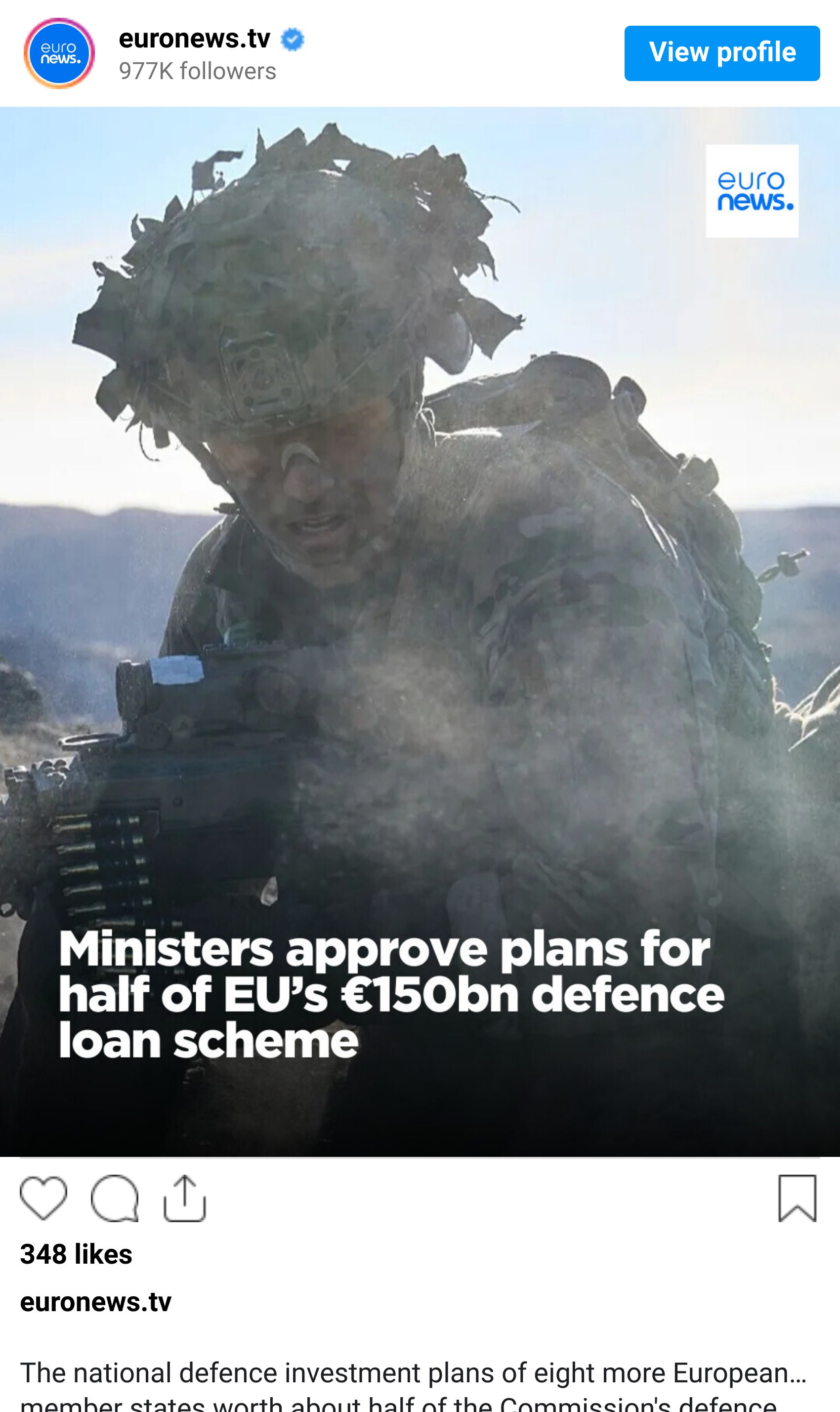
Comment: France, Czechia, and Hungary are still awaiting the EU Commission’s approval before plans can be approved by financial ministers. The loans provided through the SAFE instrument are some of Europe’s greatest leaps in its non-NATO defense resurgence, itself a strategic policy orchestrated under the ReArm Europe plan (also known as Readiness 2030).
End Brief
That concludes this brief.
Thank you for reading!
— Nick
This publication is an Open-Source Intelligence (OSINT) product and does not contain Controlled Unclassified Information (CUI) or Classified Information.
Comments represent the analysis, opinions, and estimates of The Intel Brief writer(s).