In partnership with


Pacific Weekly #88
Good morning and happy Sunday,
This is Pacific Weekly, a premium exclusive of The Intel Brief intended to keep you updated on events across the hotly contested Indo-Pacific region.
Reporting Period: February 16-22, 2026
Bottom-Line Up Front:
1. Xi Jinping recently made a rare public acknowledgment of ongoing purges within the People’s Liberation Army (PLA). He claimed the PLA has undergone political rectification while remaining loyal and operationally capable, marking his first such direct remarks on the issue since 2022. The comments come amid extensive removals of senior military and CCP officials throughout 2025 and early 2026, fueling speculation that Xi is either signaling confidence in consolidated control or warning remaining dissenters against resistance.
2. Japan has launched the first set of its pledged $550 billion investment into the United States, beginning with a $36 billion package focused on energy and industrial projects. The investment includes a $33 billion natural gas facility, a crude export terminal, and a synthetic diamond manufacturing plant.
I will be publishing a Thursday weekly update until March 8, 2026, due to my USMCR obligations (i.e. the Monday and Thursday briefs will be one). Thank you for understanding!
Xi Jinping Makes Rare Acknowledgment Of PLA Purges
Summary
Xi Jinping recently made a rare public acknowledgment of ongoing purges within the People’s Liberation Army (PLA). He claimed the PLA has undergone political rectification while remaining loyal and operationally capable, marking his first such direct remarks on the issue since 2022. The comments come amid extensive removals of senior military and CCP officials throughout 2025 and early 2026, fueling speculation that Xi is either signaling confidence in consolidated control or warning remaining dissenters against resistance.
Findings and Analysis
Xi’s Remarks: Recently, speaking in a virtual address, Xi Jinping stated that 2025 had been “unusual and extraordinary” due to the People’s Liberation Army (PLA) having “undergone revolutionary tempering in the fight against corruption” (BBC, ABC). Xi also mentioned that while the PLA has addressed such risks and made “in-depth political rectification,” much of the PLA’s personnel have remained loyal to the CCP and have proven tactically proficient and politically reliable (BBC).
The BBC states that the remarks were the first of their kind by Xi since 2022 (BBC).

Comment: One of the puzzling questions is why Xi would recognize, albeit informally and with somewhat flowerly language, that purges have taken place within the CCP and PLA and will, by all indications, continue. You will need to read the background (below) to better understand this proposition, but Xi may have recognized it for two reasons: First, that he is now confident he has removed formidable and organized dissidents, and has truly achieved a unified ideological and decision-making hierarchy in the PLA (which would be top-down, with Xi at the pinnacle. Second, that Xi has not removed formidable dissent within the CCP and PLA, and that he is aware of other cells or individuals who would challenge Xi and, in a worst-case scenario, remove him forcefully. Revealing those cards, so to speak, serves as a type of threat to coerce compliance or at least delay any dissent.
Background: When Xi Jinping took power as China’s paramount leader in 2012, he instituted a series of political and military purges in an effort to control the ideological and decision-making structure of the Chinese Communist Party (CCP). Xi’s original anti-corruption campaign was framed as rooting out “Tigers” and Flies” (i.e. the formidable dissidents who might coup Xi and the party, and the self-serving corrupt) (The Intel Brief). On December 16, 2025, Xi published an article in the CCP’s Quishi magazine which proposed “turning the knife inward” to root out ideological inconsistencies, corruption, and the undisciplined, indirectly indicating a continuation of the purges (The Intel Brief). In March, June, and October of 2025, Xi lived up to that concept, purging high-level generals and CCP officials (The Intel Brief). Most recently, in January 2026, Xi purged more senior officials: Vice Chairman Zhang Youxia (Central Military Commission), Chief of Staff Liu Zhenli (Central Military Commission), and Zhong Shaojun (Former director of the CMC’s General Office) (The Intel Brief). Rumors also suggested that in January, Xi removed upwards of 17 other Generals or senior officers, and that an imminent coup was foiled (The Intel Brief, Socialist Alternative, Vox).
Japan Launches First Major Investments Into US Economy Following Trump, Takaichi Trade Deal
Summary
Japan has launched the first set of its pledged $550 billion investment into the United States, beginning with a $36 billion package focused on energy and industrial projects. The investment includes a $33 billion natural gas facility, a crude export terminal, and a synthetic diamond manufacturing plant.
Findings and Analysis
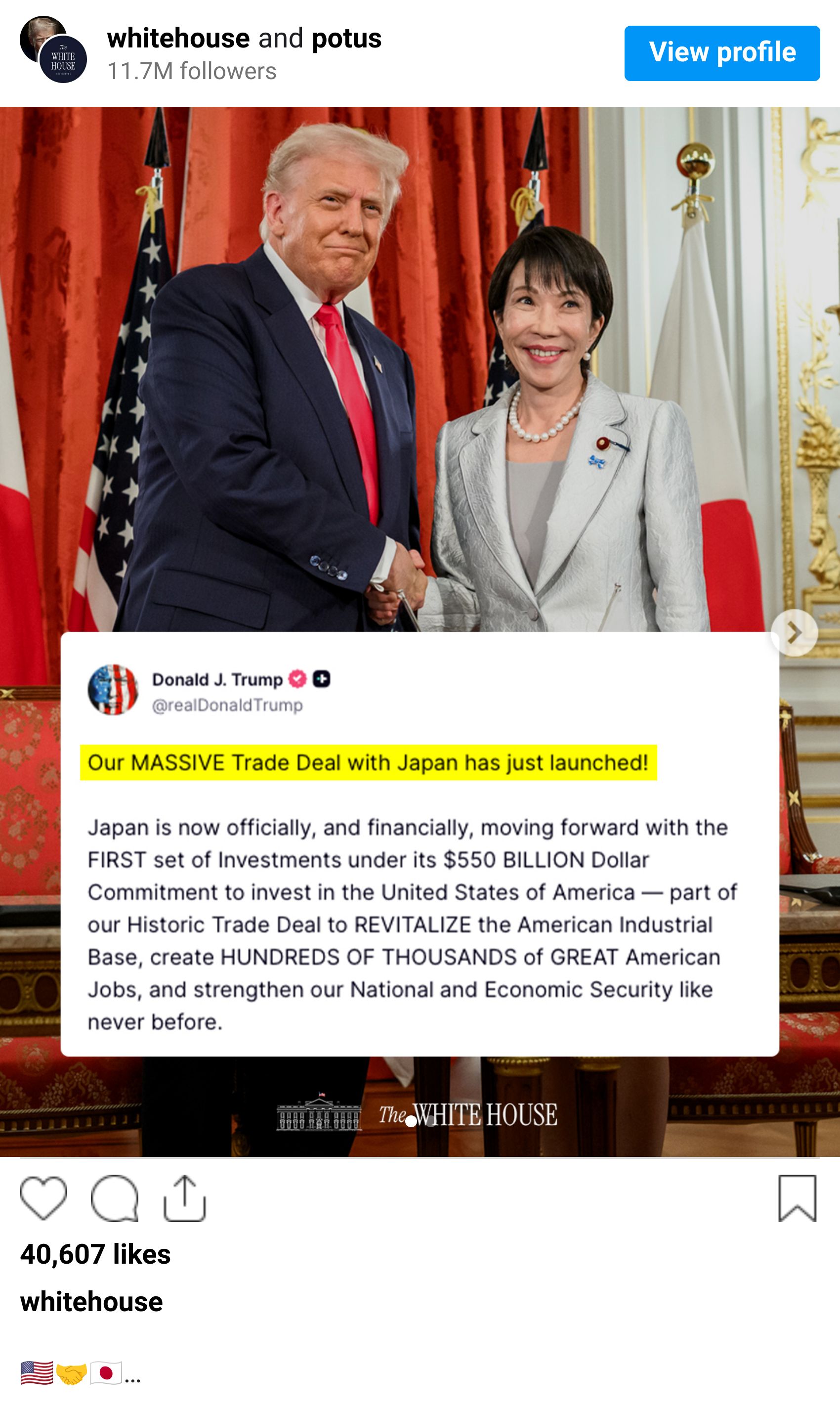
Announcement: On February 18, President Trump announced that Japan has made its first investment into the US economy under the framework of the trade deal negotiated by Trump and Prime Minister Takaichi (The White House, The New York Times). The first investment is valued at $36 billion, and includes support for oil, gas, and mineral projects across the US (Yahoo! Finance).
The deal is the first of Japan’s planned $550 billion investment into the US economy (The White House, The New York Times).
Details: According to Yahoo! Finance, the initial investment will support a natural gas facility in Ohio, a crude export terminal in the Gulf of America, and a synthetic diamond manufacturing facility in Georgia (Yahoo! Finance). The same report claims that $33 billion of that investment will be used to construct the natural gas facility in Ohio (Yahoo! Finance).
Background: On October 28, President Trump met with Prime Minister Takaichi in Tokyo, Japan (The Intel Brief). During the meeting, US and Japanese officials agreed to an initial trade agreement in which Japan pledged a $550 billion investment into the US economy (The Intel Brief, CBS News, Japan Times). In return, the US reduced tariffs on Japanese goods to 15% from 25% (CBS News, Japan Times).
Vibe code with your voice

Vibe code by voice. Wispr Flow lets you dictate prompts, PRDs, bug reproductions, and code review notes directly in Cursor, Warp, or your editor of choice. Speak instructions and Flow will auto-tag file names, preserve variable names and inline identifiers, and format lists and steps for immediate pasting into GitHub, Jira, or Docs. That means less retyping, fewer copy and paste errors, and faster triage. Use voice to dictate prompts and directions inside Cursor or Warp and get developer-ready text with file name recognition and variable recognition built in. For deeper context and examples, see our Vibe Coding article on wisprflow.ai. Try Wispr Flow for engineers.
End Brief
That concludes this edition of Pacific Weekly. Thank you for reading.
Remember, I will have a slimmed-down publication schedule through March 8, 2026, due to my USMCR obligations.
Thanks for understanding!
— Nick
This publication is an Open-Source Intelligence (OSINT) product and does not contain Controlled Unclassified Information (CUI) or Classified Information.
Comments represent the analysis, opinions, and estimates of The Intel Brief writer(s).