

Pacific Weekly #77
Good morning and happy Sunday,
This is Pacific Weekly, a premium exclusive of The Intel Brief intended to keep you updated on events across the hotly contested Indo-Pacific region.
Reporting Period: December 1-7, 2025
Bottom-Line Up Front:
1. The Philippines announced it is formalizing operational guidelines for its civilian sea patrol fleets. The effort is seen as a measure intended to deter Chinese naval incursions, especially in Manila’s territorial waters.
2. This week, various announcements from the Marine Corps suggested solid progress is being made on Force Design. These developments include the activation of a logistics unit in Okinawa, plans for a new expeditionary landing and navigation system, and the selection of a design for the Medium Landing Ship.
3. On December 2, President Trump signed the Taiwan Assurance Implementation Act into law. The legislation requires the Department of State to conduct recurring reviews and reports of all guidance governing U.S.-Taiwan relations. Taiwan’s Ministry of Foreign Affairs publicly welcomed the action, labeling it the Trump administration’s first explicitly pro-Taiwan legislation.
4. On December 6, China successfully launched its 14th batch of low-orbit internet satellites from Hainan province. This launch advances Beijing’s push to build a large-scale space-based internet network, expanding its capabilities for global communications and strengthening its position in space infrastructure.
Philippines Restoring Civilian Sea Patrol To Combat Chinese Irregular Naval Warfare
Summary
The Philippines announced it is formalizing operational guidelines for its civilian sea patrol fleets. The effort is seen as a measure intended to deter Chinese naval incursions, especially in Manila’s territorial waters.
Findings
Civilian Sea Patrol: On December 1, General Andres Centino (Ret.) confirmed that the Bureau of Fisheries and Aquatic Resources (BFAR) is completing an inventory of vessels and formalizing operational standards and guidelines for the “Bantay Dagat,” or sea patrol (The Inquirer).
BFAR states that sea patrol volunteers are tasked with detecting illegal fishing and “enforcing measures” within territorial waters (up to 15 kilometers from shore) (The Inquirer).
Why This Matters
This is an interesting update, especially because it is a sound principle but difficult to implement effectively. Some skeptics view the decision as a futile attempt to counter China’s Maritime Militia, a paramilitary, enforcement, and intelligence collection force that legally operates as fishermen (The Inquirer). Centino and supporters of the decision state that the Philippines needs to urgently expand its capabilities to monitor and enforce its control of territorial waters, regardless of China’s aggressions and greater pool of resources.
According to international law, under a 2016 arbitration and the United Nations Convention on the Law of the Sea, Manila does have the authority to create and use such a force. However, it does not mean that China will stop expanding its aggressions and incursions. Also, it does not guarantee that a conflict flashpoint will not emerge.
Force Design 2030: Marines Stand Up New Units, Issue RFI For Expeditionary Landing System, Select Landing Ship Design
Summary
This week, various announcements from the Marine Corps suggested solid progress is being made on Force Design. These developments include the activation of a logistics unit in Okinawa, plans for a new expeditionary landing and navigation system, and the selection of a design for the Medium Landing Ship.
Findings
Background: In October 2025, Marine Corps Commandant General Eric Smith issued the “Force Design Update” for 2025 (U.S. Marine Corps). General Smith’s report confirms that Force Design remains in the implementation phase (U.S. Marine Corps). The focus remains strengthening the Stand-in-Force (SIF), posturing Marines for expeditionary operations, and defeating adversaries in the First Island Chain (U.S. Marine Corps).
In the “Where We Are Going” section, General Smith highlighted efforts to enhance Marine Corps maneuverability, lethality, enabling “joint kill webs,” and expanding logistics in contested environments (U.S. Marine Corps).
Each of these updates supports the Force Design strategy:New Combat Logistics Companies: On December 1, USNI News reported that three new companies were stood up under the Combat Logistics Battalion 4 (CLB-4) at Camp Schwab, Okinawa (USNI News). A Headquarters Company, Alpha Company, and General Service Company were activated (USNI News).
This directly supports III Marine Expeditionary Force’s role as the principal Stand-in-Force in the First Island Chain (USNI News).

EPALC Request for Information: On December 1, Naval Air Systems Command published a Request for Information (RFI) asking industry leaders to provide details about flight navigation systems that facilitate landing aircraft in austere environments and adverse weather conditions (Military Times). The system, operated by expeditionary ATC Marines, would be dubbed the Expeditionary Precision Approach Landing Capability (EPALC), and would be deployable within 90 minutes of being delivered by MV-22 Ospreys or CH-53 King Stallions (Military Times).
It is likely that the EPALC will be derived from Collins Aerospace’s Joint Precision Approach Landing System (JPALS), a system used to improve carrier landings.
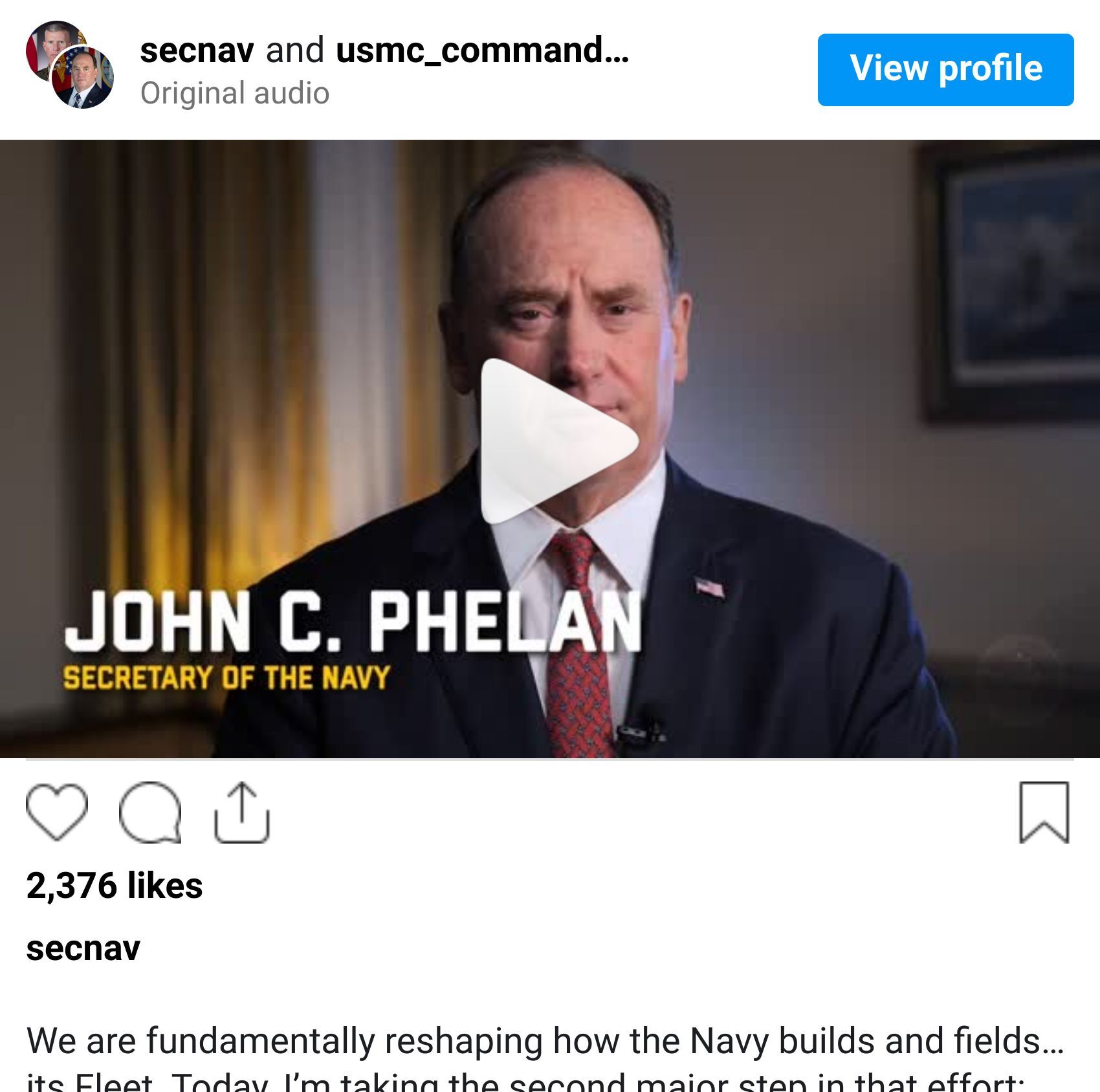
This directly supports Marine Corps logistics and maneuverability in littoral environments, and would facilitate the rapid establishment of FARPs, or Forward Arming and Refueling Points.Medium Landing Ship Design: On December 4, Secretary of the Navy John Phelan and Marine Corps Commandant General Eric Smith announced the design for the Medium Landing Ship, a core procurement target for Force Design (SECNAV). The ship will provide Marines the organic capability to embark, transport, and land Marines to littorals without piers (SECNAV). The LST-100 design by Damen Shipyards was approved by Secretary Phelan, with “no less than 35” planned for procurement (SECNAV, Damen).
Why This Matters
Force Design has faced some setbacks and criticism in the Marine Corps and military in general, but these developments mark a solid advancement of core objectives.
The most important part is that all these developments either do (or will) serve the Marine Corps’ ability to conduct and sustain expeditionary operations inside the First Island Chain (China’s Weapon Engagement Zone, or WEZ).
Trump Brings Taiwan Assurance Implementation Act Into Law
Summary
On December 2, President Trump signed the Taiwan Assurance Implementation Act into law. The legislation requires the Department of State to conduct recurring reviews and reports of all guidance governing U.S.-Taiwan relations. Taiwan’s Ministry of Foreign Affairs publicly welcomed the action, labeling it the Trump administration’s first explicitly pro-Taiwan legislation.
Findings
Background: In May 2019, the 116th U.S. Congress passed the Taiwan Assurance Act of 2019, which directs the Department of State to review its “guidance governing U.S.-Taiwan relations and to reissue such guidance” to the executive branch and Congress (U.S. Congress).
Taiwan Assurance Implementation Act: This legislation was made law by President Trump on December 2 and is an amendment to the Taiwan Assurance Act of 2019 (Focus Taiwan, Reuters). The law requires the Department of State to routinely review its guidance governing relations with Taiwan “not less than every five years” (Focus Taiwan, Reuters). The 2019 legislation required a one-time review.
Additionally, the Department of State must submit a report to the Senate and House foreign relations committees “not later than 90 days” after completion (Focus Taiwan).Taiwan’s Response: On December 3, Taiwan’s Ministry of Foreign Affairs welcomed the development, calling it “the first item of pro-Taiwan legislation” by the Trump administration (MFA ROC).
Why This Matters
This is significant legislation, because not only will it require the Department of State to review its guidance on Taiwan relations, it will provide rapid reports to change and advance policies in a timely and geopolitically relevant manner. This effectively makes Taiwanese relations embedded in U.S. foreign policy decisionmaking for the foreseeable future.
Reviews and recommendations are likely to affect the economic and security cooperation between Taipei and Washington, and could quickly lead to policies that deepen our strategic relationship.
Perhaps the most interesting component of this is the diplomatic one. The United States, while a loyal and committed partner to Taiwan, does not recognize Taiwanese sovereignty. We do not have an official embassy there, and we do not recognize it (formally) as a separate entity from China. But, now that Beijing will have to witness a regular review and advancement of the Washington-Taipei relationship, it may incrementally expand Taiwan’s de facto legitimacy abroad. This law is already a codification of diplomacy, and these reviews, in a diplomatically fragile future, could lead to that recognition and formalization, a powerful political and coercive option over China.
China Launches New Satellite Group
Summary
On December 6, China successfully launched its 14th batch of low-orbit internet satellites from Hainan province. This launch advances Beijing’s push to build a large-scale space-based internet network, expanding its capabilities for global communications and strengthening its position in space infrastructure.
Findings
Purpose: The satellite constellation is a part of China’s long-term effort to enhance its presence in the space domain. These satellites will support China’s state-controlled broadband network, which will allow for enhanced civilian, government, and military communication capabilities (Aviation News).
When you hear LEO broadband satellite, think of something similar to Starlink.
Why This Matters
First, the successful satellite launch demonstrates China’s growing competence in the space domain. The Long March-8A is one of China’s newer launch vehicles, and the recent mission was a positive proof of concept for the rapid deployment of multiple satellites.
From a power and influence perspective, we don’t often think of satellites as this kind of tool, but a LEO internet constellation will allow China to build out its own networks, improve resilience and security, and reduce dependence on Western infrastructure. In turn, this means as China grows its own space infrastructure, it can present itself as an alternative, providing Chinese services abroad and embedding CCP oversight on those systems.
Finally, it is almost certain that these satellites have a dual-use. The constellation very likely supports space-based command and control (C2) and Intelligence, Surveillance, and Reconnaissance (ISR) mission sets. As technology continues to improve (and in China’s favor), some satellites in these constellations may have an organic anti-satellite capability to be deployed during wartime.
End Brief
That concludes this edition of Pacific Weekly.
Thank you for reading!
— Nick
This publication is an Open-Source Intelligence (OSINT) product and does not contain Controlled Unclassified Information (CUI) or Classified Information.