
Curated foreign policy and national security news for professionals.
Good morning,
This is the Monday edition of The Intel Brief. Let’s begin.
Reporting Period: January 8-12, 2026
Bottom-Line Up Front:
1. As of January 12, protests have continued across Iran’s major cities. Security forces loyal to the Khamenei regime have labeled protestors as terrorists, using lethal force to quell unrest. President Trump and senior U.S. officials are weighing military and non-military intervention options.
2. Secretary Rubio stated that the United States has a three-phased plan for restoring Venezuela’s governance and economy. President Trump hosted executives of the top 17 U.S. oil and energy companies, but a plan to rebuild Venezuela’s oil industry has not been finalized.
3. On January 9, the European Council approved the EU-Mercosur deal, which has been negotiated for 25 years. The deal lacks unanimous support in the EU and has led to protests across the bloc. The deal will go to the EU Parliament for ratification.
Iran Protests Continue, U.S. Suggests Intervention
Summary
As of January 12, protests have continued across Iran’s major cities. Security forces loyal to the Khamenei regime have labeled protestors as terrorists, using lethal force to quell unrest. President Trump and senior U.S. officials are weighing military and non-military intervention options.

Findings
Background: On December 28, the Iranian Rial crashed to a historic low (The Intel Brief). Following the crash, merchants in Tehran organized a protest at the Grand Bazaar (The Intel Brief). Protests soon morphed into anti-regime protests and expanded to major cities across Iran (The Intel Brief). On January 2, President Trump stated that if the Iranian regime “[shots] and violently kills peaceful protestors,” the United States would intervene (The Intel Brief).
Recent Developments: Protests are still ongoing across Iran’s major cities, especially Tehran (CBS News). Iran has expressed willingness to use lethal force on protestors, with protestors now being designated as “terrorists” and “rioters” (ISW). As of January 10, at least 538 protestors have been killed by Iranian security forces (Santa Maria Times). More than 2,300 Iranians have been arrested (CNN).
On January 8, media confirmed that the Iranian regime had instituted an internet blackout to reduce coverage and commentary of protests, and reduce information leaving Iran (Reuters, Iran Human Rights). Reports and OSINT suggest Starlink was activated over Iran (X).
There have been more than 60 protests observed across 15 provinces (ISW).
U.S. Position: Trump administration officials have persistently voiced their support for Iranian protestors while denouncing the legitimacy of the Khamenei regime. Secretary of State Rubio stated that the United States “supports the brave people of Iran,” while President Trump, commenting on the historic protests, says the “USA stands ready to help” (Instagram, X).
Why This Matters
The longer the protests continue, and evolve into a legitimate revolution in defiance of lethal force by regime forces, the more likely it is the Khamenei regime will collapse and go into exile. The U.S. reportedly supports the return of Iranian Crown Prince Pahlavi in a regime change scenario.
For the U.S., the greatest risk is military intervention that escalates into direct conflict with Iran. It is possible that President Trump, with Israeli support, could order precision strikes on Iranian military and government targets, including Supreme Leader Khamenei.
We should expect a decision to be made this week, or by the end of January at the latest.
U.S. Details Phased Plan For Venezuela, Trump Meets With Energy Execs
Summary
Secretary Rubio stated that the United States has a three-phased plan for restoring Venezuela’s governance and economy. President Trump hosted executives of the top 17 U.S. oil and energy companies, but a plan to rebuild Venezuela’s oil industry has not been finalized.
Findings
Background: On January 3, the United States conducted a raid to capture President Maduro in Caracas, Venezuela. The raid was supported by space, cyber, and air assets and included strikes on various sites in Venezuela. Maduro and his wife remain in U.S. custody and will face trial in New York (The Intel Brief).
Three-Phase Plan: On January 7, Secretary of State Rubio briefed members of Congress on the situation in Venezuela following Operation Absolute Resolve (Fox News). Rubio later confirmed that the U.S. has a plan for Venezuela that includes stabilization, recovery, and transition phases (Fox News). Some Democrats stated they did not receive a detailed plan from the Trump administration.
Rubio clarified that the stabilization phase is highly dependent on the U.S. controlling and rebuilding Venezuela’s oil industry and export capability (Fox News). The recovery phase reportedly includes efforts to ensure American companies can do business in Venezuela, in addition to releasing political prisoners, granting amnesty, and allowing the Venezuelan diaspora to return and assist with new governance (Fox News).
There are sparse details on the transition phase, but speculation is that the end state will be a democratic Venezuela with free elections.
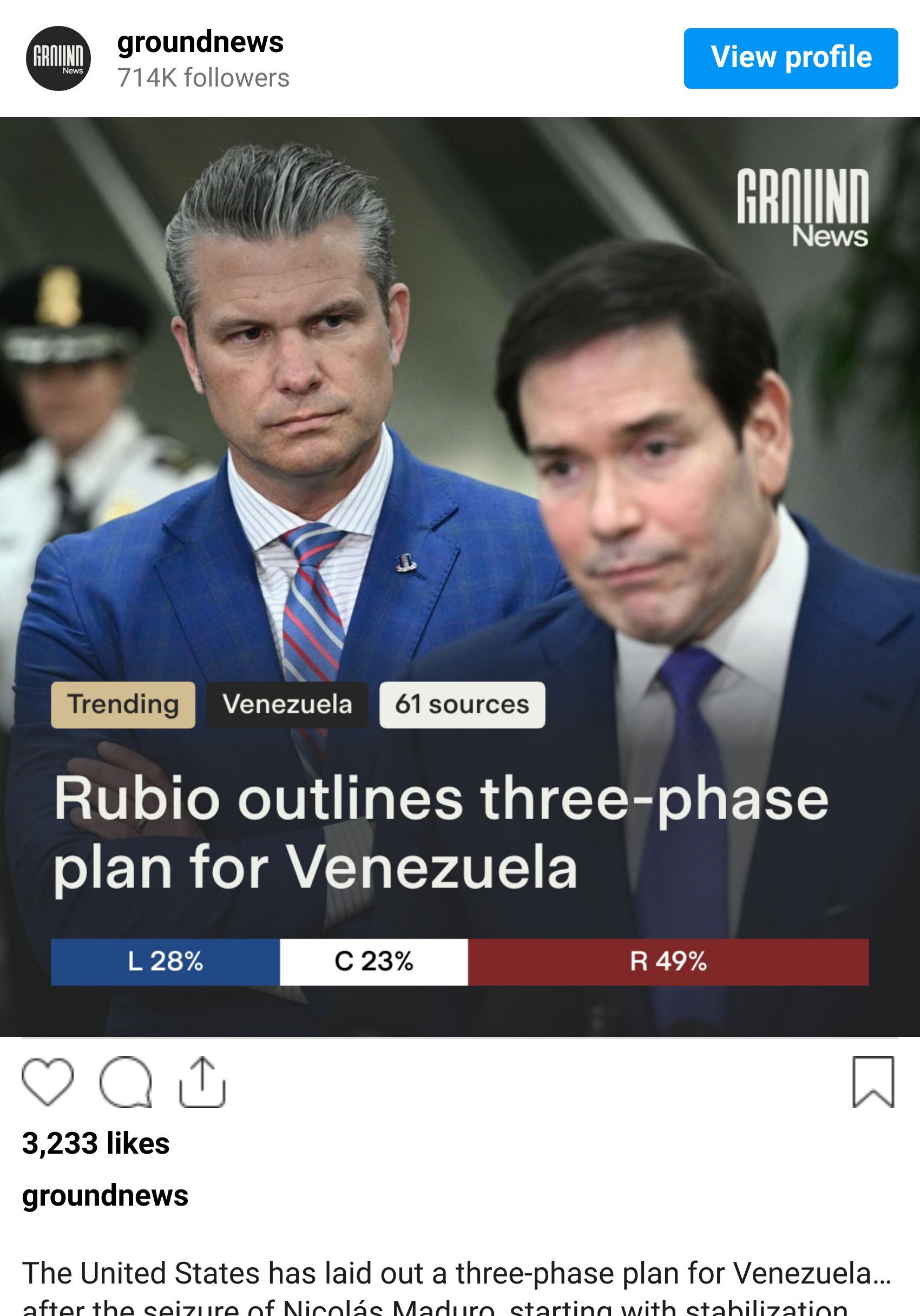
Trump and Oil Companies: On January 9, President Trump met with the executives of major oil and energy companies at the White House to discuss their interest in reentry and reinvestment in Venezuela (Politico, The New York Times). Despite Trump previously claiming American companies were willing to spend $100 billion to rebuild Venezuela’s oil infrastructure, no company provided the administration firm commitments (Politico, The New York Times). Trump was accompanied by Secretary of State Rubio, Secretary of War Hegseth, Secretary of Energy Wright, and Secretary of the Interior Burgum (Politico). Executives from 17 companies attended the meeting, including from Chevron, Exxon, Conoco Phillips, Haliburton, Marathon, and Shell (Politico, The New York Times).
Why This Matters
The principal risk is that if any stage fails or is negatively delayed, the United States may continue to conduct military operations in Venezuela in support of political and energy goals.
Similarly, any regime fragility, disalignment with Washington, or perceived risk could prompt intervention. Finally, as the Venezuelan policy continues to be fulfilled, the Trump admin may feel emboldened to begin similar projects elsewhere, such as Cuba, Colombia, or Mexico.
European Union Approves Mercosur Deal
Summary
On January 9, the European Council approved the EU-Mercosur deal, which has been negotiated for 25 years. The deal lacks unanimous support in the EU and has led to protests across the bloc. The deal will go to the EU Parliament for ratification.
Findings
Background: On December 5, the European Commission announced it had finalized an EU-Mercosur partnership agreement (The Intel Brief). The agreement outlined terms for a strategic partnership and free-trade agreement, initially supported by both blocs despite a lack of unanimous support inside Europe (The Intel Brief). Mercosur is a trade bloc established in 1991 and expanded in 1994. Mercosur includes Argentina, Bolivia, Brazil, Paraguay, and Uruguay as members, and 10 associated, suspended, or observing nations (Mercosur).
Signing the Proposal: On January 9, the European Council announced that it had approved the framework for the comprehensive partnership and free-trade agreement (European Council). The partnership is known as the EU-Mercosur Partnership Agreement (EMPA), while the trade deal is known as the Interim Trade Agreement (iTA) (European Council).
EMPA Details: The EMPA is a framework for “political dialogue, cooperation and comprehensive sectoral engagement” that progresses EU-Mercosur efforts to strengthen “sustainable development, environment and climate action, digital transformation, human rights, mobility, counterterrorism, and crisis management” (European Council). The framework also details provisions for closer collaboration on international peacekeeping and migration (European Council).
iTA Details: The iTA will act as a “liberalisation” pillar for EU-Mercosur trade while both blocs wait for the EMPA to be fully ratified and integrated (European Council). It offers “tariff reductions and open access” to strategic sectors like agriculture, automotive, pharmaceuticals, chemicals, finance, and services (European Council).
Controversy: The EU-Mercosur deal does not have unanimous support in Europe. In particular, France and Ireland oppose the deal, with protests erupting in both countries (The Guardian, Euro News). Protests have also formed in Poland and Spain. Italy initially opposed the deal before Prime Minister Meloni negotiated protections for Italian farmers (Politico).
Why This Matters
The deal will now go to the European Parliament for ratification. There is likely to be some opposition. European states with large domestic farming industries, like France, Ireland, and Poland oppose the deal because of how it undercuts European agriculture. Industrial nations, notably Germany, support the deal due to lowered costs for sending cars to South America.
French President Macron also made a general criticism, stating that the deal (which has been negotiated for 25 years) is outdated and based on old principles.
Additionally, the deeper partnership could degrade American-European relations, especially for the remainder of Trump’s presidency, which is being partially defined by a resurgence in the Monroe Doctrine.
In the long term, the Mercosur deal could be cause for grassroots anti-EU or EU-exit protests, movements, and political platforms.
End Brief
That concludes this brief.
Thank you for reading!
— Nick
This publication is an Open-Source Intelligence (OSINT) product and does not contain Controlled Unclassified Information (CUI) or Classified Information.