
Curated foreign policy and national security news for professionals.
Good morning,
Welcome to the Monday morning edition of The Intel Brief. Let’s get you up to speed on the major geopolitical updates from the weekend.
Reporting Period: January 15-19, 2026
Bottom-Line Up Front:
1. On January 17, President Trump announced new tariffs against European nations that have backed Greenland’s sovereignty and opposed a US purchase or seizure of the island nation. European nations have backed Greenland and Denmark. Greenland’s prime minister has reaffirmed alignment with Denmark, NATO, and the EU, and that the nation is not for sale.
2. This week, Syria and Kurdish forces reached a ceasefire. Syria’s president has formally recognized the Kurds as an ethnic group with legal and cultural guarantees. The truce reached between President al-Sharaa and the Kurdish SDF is intended to integrate the Kurds into a new system of governance and facilitate the full stabilization and reconstruction of Syria.
3. From January 19-23, world leaders will meet in Davos, Switzerland, for the 2026 World Economic Forum annual meeting. There are five guiding questions that make up the agenda. Given the forum’s focus on global competition and rising multilateralism, we can expect leaders to address ongoing crises like Ukraine, Iran, and Greenland and NATO stability.
Trump Issues Tariffs On European Allies Due To Greenland Dilemma
Summary
On January 17, President Trump announced new tariffs against European nations that have backed Greenland’s sovereignty and opposed a US purchase or seizure of the island nation. European nations have backed Greenland and Denmark. Greenland’s prime minister has reaffirmed alignment with Denmark, NATO, and the EU, and that the nation is not for sale.
Findings
Background: On January 14, Vice President Vance and Secretary of State Rubio met with the foreign ministers of Denmark and Greenland in Washington, DC (The Intel Brief). In response to President Trump’s hostile rhetoric, France, Germany, the United Kingdom, the Netherlands, Denmark, Norway, Sweden, and Finland all deployed troops, military assets, or military support to Greenland under Operation Arctic Endurance (Maven Mapping).
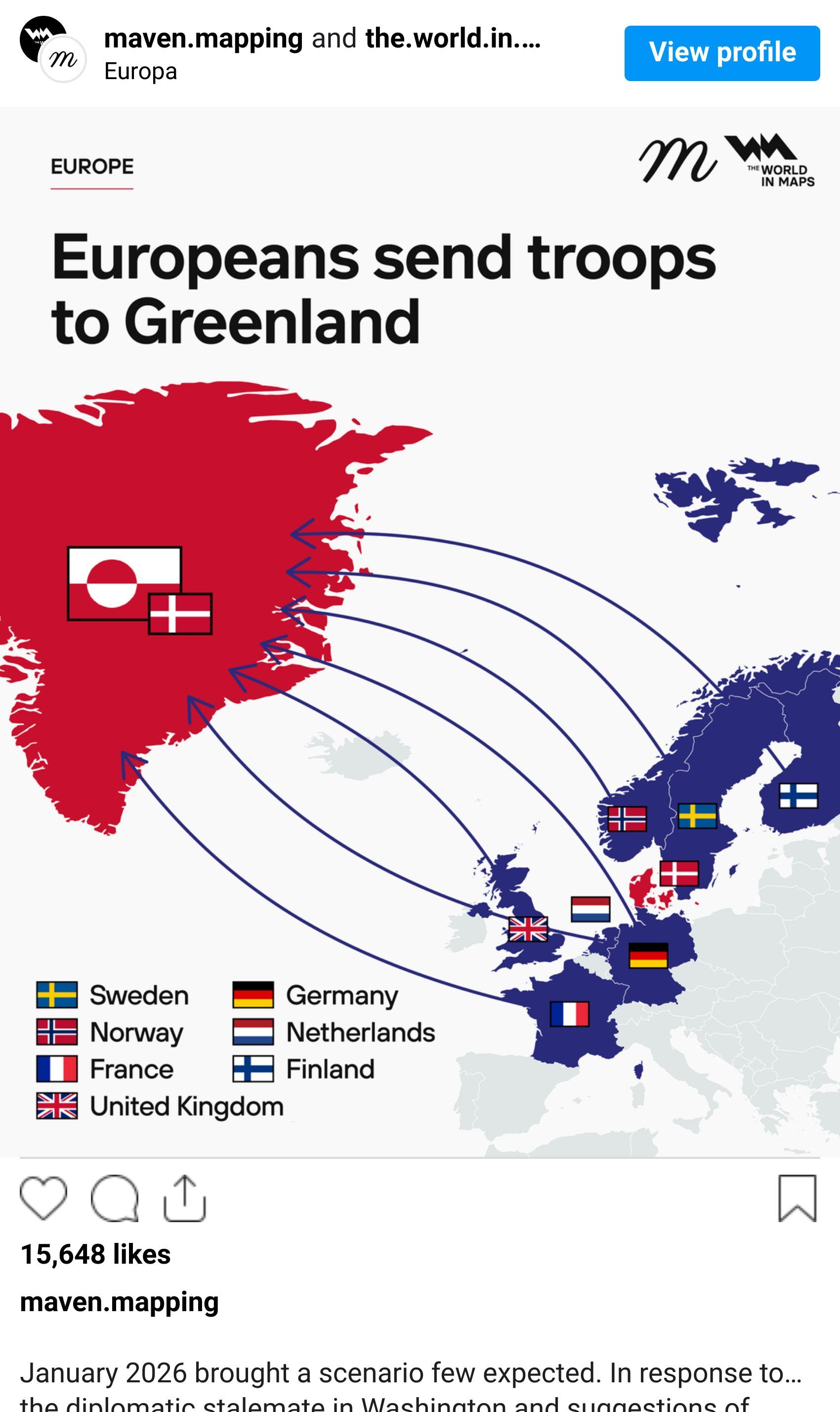
Tariffs and the Greenland Demand: On January 17, President Trump stated that beginning on February 1, 2026, Denmark, Norway, Sweden, France, Germany, the United Kingdom, the Netherlands, and Finland will be charged a 10% tariff on goods sent to the United States due to those nations sending troops or other military support to Greenland (The White House). Trump confirmed that the tariff will increase to 25% on June 1, 2026, until “such time as a Deal is reached for the Complete and Total purchase of Greenland” (The White House).
Trump stated that the United States is willing to begin negotiations with “Denmark and/or any of these Countries that have put so much at risk” (The White House).
Trump maintains the US acquisition of Greenland is necessary for the Golden Dome air defense network being constructed, and cites Russian and Chinese interest in acquiring the northern territory for themselves (The White House). Trump also clarified that Europe lacks the interest and capability to properly govern and defend Greenland, or maximize its strategic value.
Greenland’s Response: As of January 17, Greenland has experienced its largest-ever protests against President Trump’s rhetoric and desire to acquire Greenland (PBS). Greenland Prime Minister Nielsen has reportedly led protests in Nuuk, where he stated Greenland remains aligned with Denmark, NATO, and the European Union, and that the nation is not for sale.
Europe’s Response: The majority of the involved parties issued individual statements following President Trump’s remarks on Truth Social.
France denounced American tariff threats and stated it would uphold “European sovereignty” in Europe and Greenland (X). The UK stated that the future of Greenland is “a matter for Greenlanders and the Danes,” and that London will work closely with Washington to address the issue (X). Like France, Germany took a harsher and more direct stance. Chancellor Merz stated that Germany will “stand resolutely and united by the side of Denmark and the people of Greenland,” and that American tariffs are unnecessarily hostile and escalatory (X).On January 6, a joint statement by European states was issued alongside a joint statement by Europe’s Nordic nations (Elysee, Government of Sweden). On January 17, the European Commission and European Council issued a joint statement of solidarity with Denmark and Greenland (EU). The EU parliament is reportedly planning to block the approval of the previously agreed EU-US Trade Deal due to Trump’s new tariff threats (Bloomberg).
Why This Matters
As the dispute for possession of Greenland continues, the deterioration of US and European relations is likely to accelerate, as is the stability of NATO. Trump’s tariff threats, which have also undermined US-EU trade, are likely to degrade bilateral relations with key European partners.
It is uncertain what steps the Trump admin will take next; whether it will keep pace or take a step back. It is very likely that Secretary Rubio will meet with his Danish and Greenlandic counterparts, and possibly with European officials.
Syrian President Announces Truce With Kurdish Faction
Summary
This week, Syria and Kurdish forces reached a ceasefire. Syria’s president has formally recognized the Kurds as an ethnic group with legal and cultural guarantees. The truce reached between President al-Sharaa and the Kurdish SDF is intended to integrate the Kurds into a new system of governance and facilitate the full stabilization and reconstruction of Syria.
Findings
I will offer more of a timeline of events to better present the recent developments in Syria:
Background: Since al-Sharaa’s rise to the Syrian presidential office, Syrian forces have remained in conflict with the Kurdish Syrian Democratic Force (SDF), destabilizing Syria’s reconstruction and perpetuating ethnic violence.
Al-Sharaa’s Promise: On January 16, President al-Sharaa issued a special decree that guarantees Kurdish rights and legal and cultural autonomy in Syria. Decree Number 13 recognizes Kurdish as a national language and acknowledges Kurdish as a separate ethnicity (The Guardian).
SDF Compliance: In order to quell violence, President al-Sharaa urged Kurdish forces to withdraw to areas east of Aleppo, Syria. The SDF commander, Mazoum Abdi, confirmed that the SDF would comply with al-Sharaa’s request and return to Kurdish territories (AP News).
Reported Betrayal: On January 17 and 18, reports suggested that Syrian forces had continued to advance into Kurdish territories, seizing terrain and fighting with SDF forces and Kurdish civilians (The Guardian). On January 17, CENCOM Commander Admiral Cooper issued a statement urging Syrian forces to cease offensive operations between Aleppo and al-Tabqa (CENTCOM).
Syrian-Kurdish Truce: On January 18, despite the continued violence, President al-Sharaa announced a 14-Point truce with the Kurds (Reuters, Barron’s). The agreement includes a ceasefire (Barron’s). The deal also includes the integration of Syrian and Kurdish SDF forces into the defense and interior ministries (Barron’s). It also includes the handover of some Kurdish-held territories (like Raqa) to the Syrian government (Barron’s).
Why This Matters
The truce offers a narrow chance to stabilize northern Syria and reduce fighting that has stalled reconstruction and displaced civilians. It also tests whether Damascus is willing and able to follow through on political concessions rather than relying on force after securing compliance. For the United States, the agreement directly affects the future of the SDF, a key counter-ISIS partner, and the durability of U.S. influence east of the Euphrates. The integration of Kurdish forces into Syrian security institutions could either reduce long-term conflict or become a mechanism for regime control and repression. If the truce collapses, it will likely accelerate Kurdish distrust, renewed violence, and external intervention by regional actors.
World Economic Forum Convenes Today
Summary
From January 19-23, world leaders will meet in Davos, Switzerland, for the 2026 World Economic Forum annual meeting. There are five guiding questions that make up the agenda. Given the forum’s focus on global competition and rising multilateralism, we can expect leaders to address ongoing crises like Ukraine, Iran, and Greenland and NATO stability.
Findings
Agenda: According to the WEF website, the 2026 annual meeting will focus on addressing these key questions:
How can we cooperate in a more contested world?
How can we unlock new sources of growth?
How can we better invest in people?
How can we deploy innovation at scale and responsibly?
How can we build prosperity within planetary boundaries?
Why This Matters
The agenda and discussions that emerge within the WEF annual meetings typically influence the strategy of regional powers and blocs, but are formalities for truly multipolar and influential powers like the US and China.
Typically, ongoing geopolitical crises and flashpoints find their way into the agenda, so we are likely to observe statements, discussions, and updates on Ukraine, Greenland, Iran and the Middle East, and security in the Pacific.
Do not monitor the WEF expecting major decisions to be organized by a collective, but expect leaders to use the forum and its prestige to boost their own platform or engage in bilateralism.
End Brief
That concludes this briefing. See you Thursday!
Thanks for reading,
— Nick
This publication is an Open-Source Intelligence (OSINT) product and does not contain Controlled Unclassified Information (CUI) or Classified Information.