

Curated foreign policy and national security news for professionals.
Good morning,
I hope you had a nice weekend. Let’s look at some significant geopolitical updates since Thursday.
Reporting Period: February 12-16, 2026
Bottom-Line Up Front:
1. Vice President Vance went on a historic diplomatic trip to Armenia and Azerbaijan. The trip marks America’s growing interest in the region as Russia’s national power wanes. The visit included the announcement of cooperation on security, infrastructure, and nuclear energy.
2. From February 13 to 15, the Munich Security Conference convened. At the conference, Secretary Rubio delivered a keynote speech. Rubio ensured the perpetual unity and shared strategic interests between the US and Europe. He also highlighted where the West has failed, and that Europe must reform.
3. American, Russian, and Ukrainian diplomats will meet this week to continue peace talks. The trilateral will convene in Switzerland, and could yield a ceasefire framework and progress towards a meeting between heads of state.
Vance Visit Signals Greater Strategic Interest In Caucasus Region
Summary
Vice President Vance went on a historic diplomatic trip to Armenia and Azerbaijan. The trip marks America’s growing interest in the region as Russia’s national power wanes. The visit included the announcement of cooperation on security, infrastructure, and nuclear energy.
Findings and Analysis
Diplomatic Visits: From February 9 to 11, Vice President Vance visited Armenia and Azerbaijan (The Washington Post). Vance is the first sitting American Vice President to visit Armenia (AP News). The trip was explicitly tied to promoting the “Trump Route for International Peace and Prosperity,” a proposed transportation and trade corridor that will link Azerbaijan with the Nakhchivan exclave (TRT World). In Armenia, Vance and Prime Minister Pashinyan announced a civil nuclear cooperation agreement (CFR). The US also announced the sale of drones, computer chips, and surveillance technologies to Armenia as a means of boosting its technology and defense strategies (The National).
Comment: Vance’s visit is historic and strategically forward-thinking. It transparently shows the US’s intention to expand diplomatic, security, and economic partnerships in the Caucasus region, an area that is traditionally considered Russia’s sphere of influence and central to China’s Belt and Road Initiative. Similarly, it undermines Russia’s energy export market (due to the nuclear partnership with Armenia), and hinders direct land trade between Russia and Iran. TRIPP is a major geopolitical gain for the US, especially as Armenia seeks European alignment and non-member cooperation with NATO.
Background: On September 27, 2020, the decades-long frozen conflict between Armenia and Azerbaijan over Nagorno-Karabakh resumed (Crisis Group). The conflict lasted for six weeks before Russia brokered a ceasefire, granting Azerbaijan control over Nagorno-Karabakh and adjacent territories following its battlefield successes (Crisis Group). Following Russia’s diplomatic intervention, and no military support through CSTO obligations to Armenia, Prime Minister Pashinyan suggested Armenia would leave the CSTO (The Intel Brief). At that time, the US Ambassador offered for the US to oversee negotiations and cooperate on security and economy, a strategic measure to ensure a lasting peace through mutual interests (The Intel Brief). It was that sentiment, and the offer to cooperate strategically with both sides, that led the Trump administration to secure a peace deal to end the conflict and reestablish relations between Baku and Yerevan (The Intel Brief).
Munich Security Conference Convenes; US Outlines Strategic Goals With NATO, EU
Summary
From February 13 to 15, the Munich Security Conference convened. At the conference, Secretary Rubio delivered a keynote speech. Rubio ensured the perpetual unity and shared strategic interests between the US and Europe. He also highlighted where the West has failed, and that Europe must reform.
Findings and Analysis
2026 Conference: From February 13 to 15, world leaders, prominent politicians, leading thinkers, and businessmen convened for this year’s Munich Security Conference. The MSC had a massive 26-page agenda, ranging from trade, energy, Ukraine, nuclear proliferation, NATO and Europe, the Indo-Pacific, and international peacekeeping (MSC). The MSC also published the “Munich Security Report 2026,” a document detailing the leading geopolitical flashpoints, conflicts, risks, and areas for focus and improvement (MSC).
Rubio’s Speech: On February 14, Secretary of State Rubio delivered his keynote speech at the MSC (Department of State). In his speech, Rubio highlighted the United States’ perpetual alignment with Europe and NATO (MSC). However, Rubio also stated that policies on migration, climate, and transnational governance (much of what Europe peddles) have been detrimental to Western and European ambitions (MSC). In his speech, he called for cooperation on interests that will “build a new Western century” (MSC).
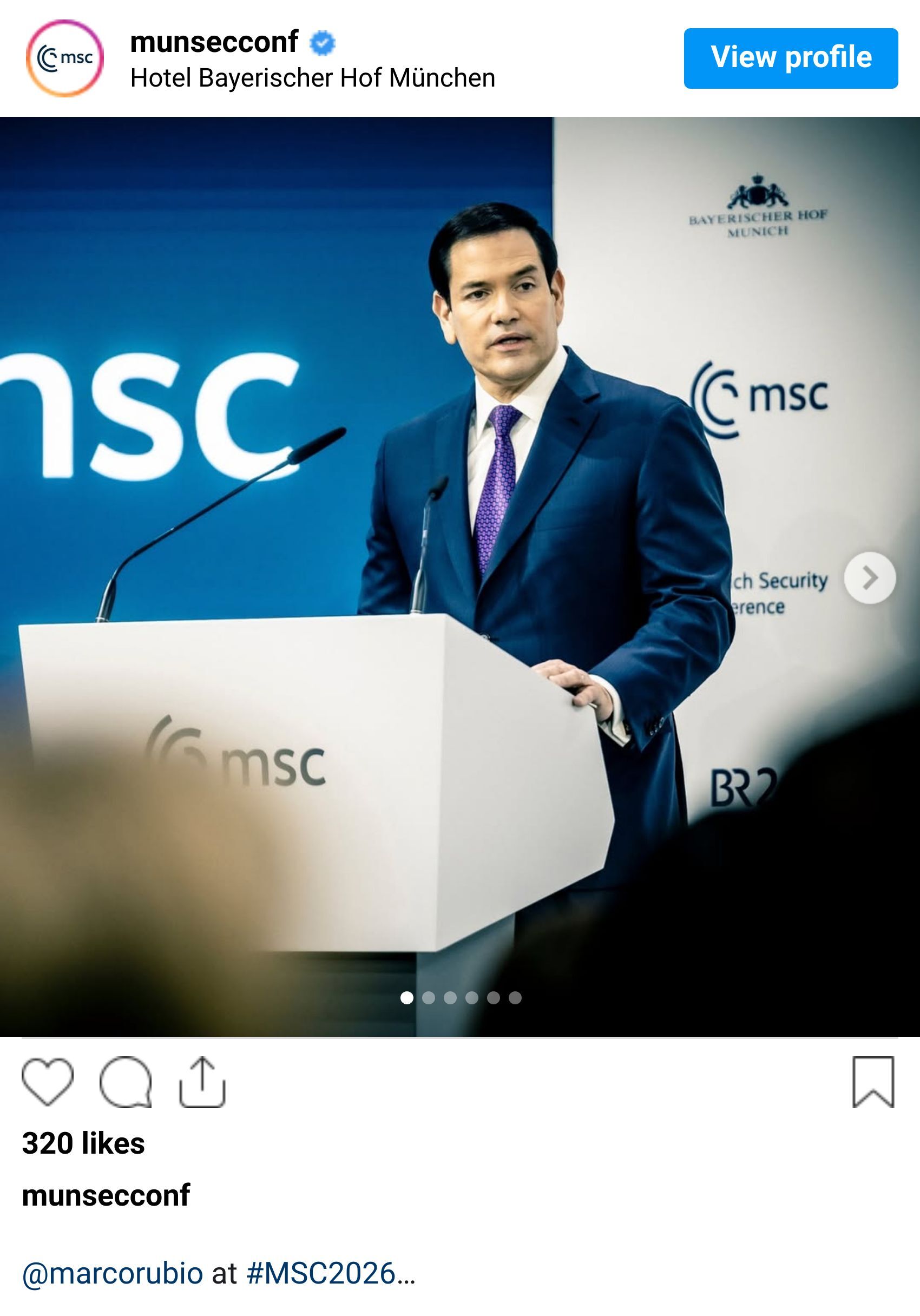
Comment: Rubio’s speech reflects two sides of the US’s approach to Europe which have come to characterize the Trump admin’s approach: Reaffirming NATO and transatlantic unity while simultaneously pressuring Europe and its governments to accelerate their competitiveness and security.
Continued Ukraine Peace Talks Scheduled This Week
Summary
American, Russian, and Ukrainian diplomats will meet this week to continue peace talks. The trilateral will convene in Switzerland, and could yield a ceasefire framework and progress towards a meeting between heads of state.
Findings and Analysis
Background: On February 5, trilateral talks between the US, Ukraine, and Russia continued in the United Arab Emirates (The Intel Brief). The first trilateral talks since 2022, when the war began, convened on January 23, 2026 (The Intel Brief). Initial feedback from the US’s lead envoy, Steve Witkoff, characterized the talks as “constructive,” with plans for future talks being orchestrated (The Intel Brief).
New Talks: A new round of trilateral peace negotiations, confirmed by President Zelenskyy, is scheduled for February 17 and 18, 2026, in Switzerland (Politico).
Comment: There have been sparse details of the previous trilateral negotiations, but their continuation suggests progress is being made towards a meeting of heads of state (i.e. Trump, Zelenskyy, and Putin), and possibly an initial ceasefire. Zelesnkyy has asked the US to be more stern with demands its makes of Russia, and to defend Kyiv’s interests (CBC). Interestingly, Russia appears to have tried to negotiate for the future, post-ceasefire, with reports claiming that Russia may return to using the dollar for major trade, or that joint energy ventures are in the works (Kobeissi Letter). This also comes as Trump expressed interest in a new nuclear deal with Russia, one to replace New START.
End Brief
That concludes this brief.
Thank you for reading!
— Nick
This publication is an Open-Source Intelligence (OSINT) product and does not contain Controlled Unclassified Information (CUI) or Classified Information.
Comments represent the analysis, opinions, and estimates of The Intel Brief writer(s).