

Curated foreign policy and national security news for professionals.
Good morning,
This is the Monday morning edition of The Intel Brief. Let’s take a look at the major updates from the weekend.
Reporting Period: December 11-15, 2025
Bottom-Line Up Front:
1. On December 16, during the European Parliament session, there will be a debate on military mobilization. On December 17, EU officials are expected to vote on implementing the Military Mobility Plan proposed in November. The mobility plan would increase defense-related infrastructure budgets and laws so that European forces can easily deploy across the region in the event of conflict.
2. On December 11, Ukraine submitted a revised peace proposal to Washington. The plan is aimed at restarting stalled negotiations and securing Trump’s support. The proposal reportedly softens Ukraine’s territorial and security concerns in exchange for demilitarized regions and bilateral security guarantees.
3. On December 10, a joint U.S. force seized a sanctioned oil tanker operating off the coast of Venezuela, citing violations of sanctions related to illicit oil trafficking linked to Iran. The action has triggered sharp condemnation from Caracas and its regional partners, escalating diplomatic tensions in the Western Hemisphere and signaling a more assertive U.S. approach to maritime sanctions enforcement.
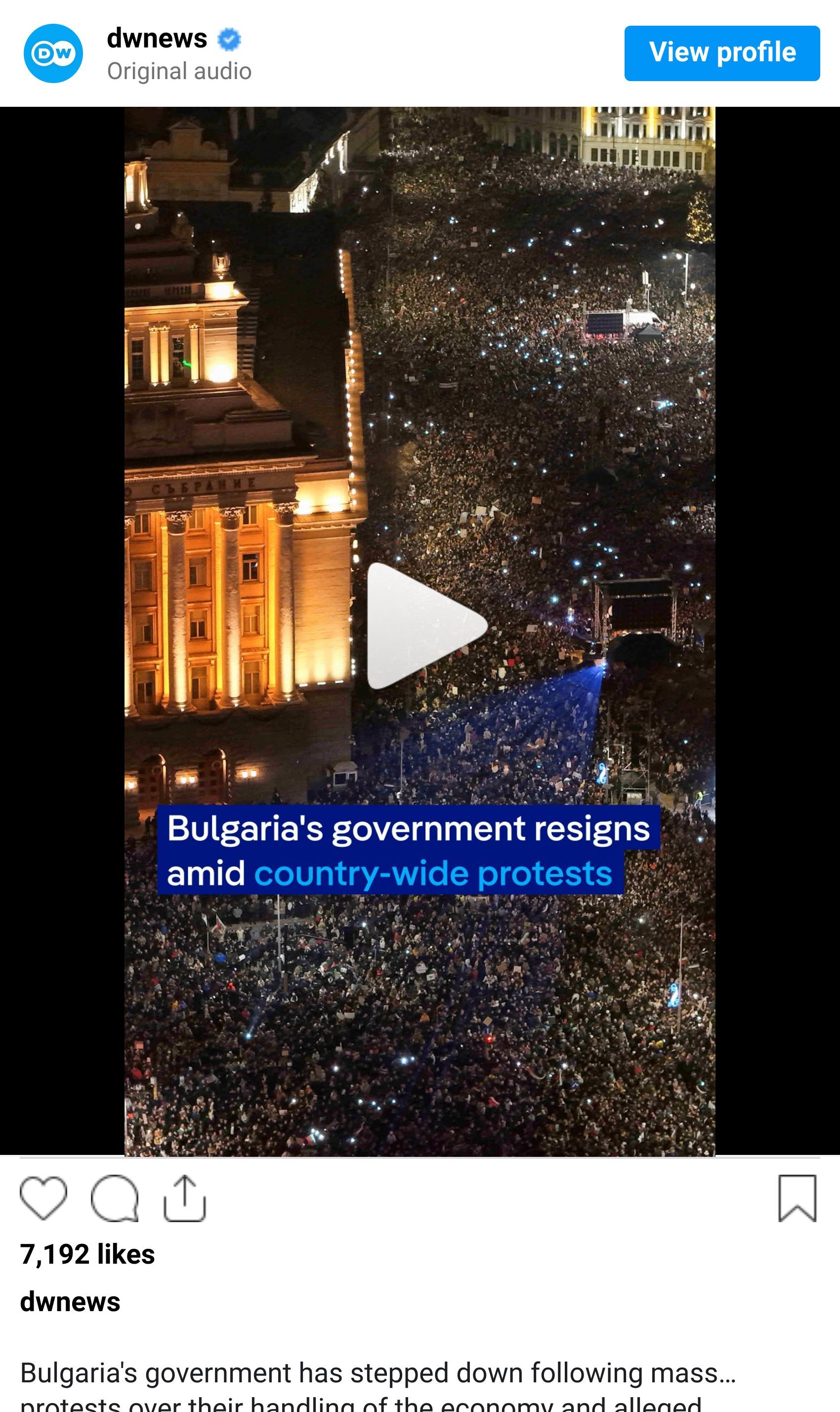
4. On December 11, Bulgaria’s government resigned amid widespread anti-corruption protests in Sofia. The political collapse comes just weeks before Bulgaria is scheduled to join the Eurozone, injecting uncertainty into Sofia’s domestic stability and its short-term governance during a critical economic transition.
EU To Vote On Military Mobilization Strategy, Establish “Military Schengen” Zone
Summary
On December 16, during the European Parliament session, there will be a debate on military mobilization. On December 17, EU officials are expected to vote on implementing the Military Mobility Plan proposed in November. The mobility plan would increase defense-related infrastructure budgets and laws so that European forces can easily deploy across the region in the event of conflict.
Findings
Background: In March 2025, the EU Commission published a White Paper on EU Defense readiness as it relates to the ReARM Europe Plan (A.K.A. Readiness 2030) (EU Commission). Military mobility, infrastructure modernization, and defense industry transformation were identified as priority areas for Europe (EU Commission).
On November 19, a proposal to establish “a framework of measures to facilitate the transport of military equipment, goods and personnel across the Union” was presented by the European Commission (EU Commission).
Similarly, on November 24, the EU Parliament drafted a resolution to create a “military Schengen area” (Project Cargo Journal).
Plenary Session: From December 15 to 18, 2025, the EU Parliament will convene in Strasbourg, France (European Parliament).
On December 16, a debate on military mobilization is scheduled, with voting planned for the following day, December 17 (Legislative Observatory European Parliament).Additional Defense Items: The parliament is scheduled to address various defense-related issues and legislation, including (European Parliament):
Monday: “Incentivising defence-related investments in the EU budget to implement the ReArm Europe Plan”.
Tuesday: “European Defence Readiness 2030: assessment of needs” and “Continuous Belarusian hybrid attack against Lithuania”.
Wednesday: “Preparation of the European Council meeting of 18-19 December 2025, in particular the need to support Ukraine, transatlantic relations and the EU’s strategic autonomy”, “The deepening democratic crisis in Georgia”, and “Cases of pro-Russian espionage in the European Parliament”.
Thursday: “Continuous Belarusian hybrid attacks against Lithuania”.
Why This Matters
This vote, and the parliamentary session in general, target one of Europe’s most fundamental military weaknesses. Europe needs to rapidly address its issues regarding dated infrastructure, coordinating transnational military movements, a lack of dual-use infrastructure, and insufficient logistical hubs.
If approved, the funding would help Europe with its logistical and infrastructure issues, while the military Schengen zone would help with bureaucratic and legal delays regarding one state moving troops through another during a crisis.
The plan also signals a shift in onus, where European leaders, pressured by the security environment and the transatlantic tension, are beginning to make proactive decisions, rather than reactive ones. Europe’s deterrence problem is no longer just spending levels, but includes bridges that cannot carry tanks, tunnels too small for heavy transport, and permit systems that treat military convoys like commercial freight.
Politically, this deepens Europe’s assumption of responsibility for its own defense while tightening EU–NATO integration. It aligns with U.S. pressure for Europe to shoulder more of the conventional burden, but success depends on execution. Funding cuts, slow permitting, or national carve-outs would leave “Military Schengen” as a paper reform; useful in politicking, but irrelevant if unfulfilled.
Ukraine Sends Updated Peace Proposal To Washington
Summary
On December 11, Ukraine submitted a revised peace proposal to Washington. The plan is aimed at restarting stalled negotiations and securing Trump’s support. The proposal reportedly softens Ukraine’s territorial and security concerns in exchange for demilitarized regions and bilateral security guarantees.
Findings
Presented Revisions: On December 11, an unnamed official told ABC News that Ukraine has sent Washington a revised 20-point peace plan (ABC News). ABC News reports the revised plan addressed “territories and control over the Zaporizhzhia Nuclear Power Plant”, and that Ukrainian and U.S. officials are likely to be discussing security guarantees for Kyiv (ABC News).
Germany, taking a leading role in representing Europe, invited the United States to join a peace talk in Berlin (POLITICO).Free Economic Zone: Ukraine’s revised plan reportedly proposes the establishment of a demilitarized “free economic zone” in the Donbas region (POLITICO). The revision is an attempt to persuade President Trump into supporting the revised proposal, so that American firms could operate in the region and, by association, retain security guarantees from Washington.
Zelenskyy views the proposal as a reasonable “compromise” since both Russian and Ukrainian troops would be barred from entering the zone (POLITICO).
NATO Membership: On December 14, reports claim that President Zelenskyy has offered to abandon the pursuit of Ukrainian NATO membership in exchange for security guarantees from Europe and the United States (Financial Times).
External Pressure: The Kyiv Independent reports that the European Union has agreed to freeze Russian central bank reserves, totaling $245 billion in assets (Kyiv Independent). Europe plans to use some of the funds to provide Ukraine loans based on the possession of those assets (Kyiv Independent). The report claims Ukraine, without foreign support, “will run out of cash by mid-2026 (Kyiv Independent).
Why This Matters
Ukraine foregoing NATO accession and proposing a free economic zone in the Donbas suggests Zelenskyy is nearly ready to begin talks that involve Russia directly. Previously, retaining territory and joining NATO were Zelenskyy’s most desired plans to acquire security guarantees from the West. But, since Ukraine is losing the war on an attrition front, it appears Zelenskyy is pushing a peace proposal based on battlefield realities.
It is uncertain if the U.S. will send diplomats to talks in Berlin, or if Trump and Zelenskyy will speak before the next major round of talks.
U.S. Implements Sanctions, Seizes Tanker In Escalation To Venezuela Situation
Summary
On December 10, a joint U.S. force seized a sanctioned oil tanker operating off the coast of Venezuela, citing violations of sanctions related to illicit oil trafficking linked to Iran. The action has triggered sharp condemnation from Caracas and its regional partners, escalating diplomatic tensions in the Western Hemisphere and signaling a more assertive U.S. approach to maritime sanctions enforcement.
Findings
Tanker Seizure: On December 10, a force of U.S. Marines, Coast Guardsmen, and special operators seized The Skipper off the Venezuelan coast (CBS News). The Attorney General stated the tanker violated sanctions by transporting oil to Iran (CBS News). The tanker was sanctioned by the U.S. Treasury in 2022, and suggests the U.S. may expand maritime law enforcement operations to pressure the Maduro regime (CBS News).
Venezuela Response: Venezuela condemned the seizure of The Skipper, calling the operation an “act of piracy” (BBC). Cuba’s foreign ministry called the operation an act of “maritime terrorism” (The Guardian).
Ground Strikes: Despite some Congressional lawmakers looking to restrict the military strikes in the Caribbean, President Trump has stated that strikes on ground targets are “going to start” (Global News, NJ SPotlight News).
Why This Matters
The seizure of The Skipper sets a new precedent for U.S. maritime law enforcement, signaling that Washington is willing to use direct, interdiction-based operations to enforce pressure on Venezuela and its partners, not just financial sanctions. By targeting illicit oil shipments tied to Iran, the U.S. is actively constricting one of the Maduro regime’s leading revenue streams and is raising the operational risk for states and companies willing to help Caracas evade sanctions.
Combined with escalating rhetoric about potential strikes and expanded operations in the Caribbean, this approach suggests a deliberate effort to accelerate economic and political pressure on Maduro’s government, accelerating regime change before overt military intervention.
Bulgarian Government Resigns Amid Protests And Before Joining Eurozone
Summary
On December 11, Bulgaria’s government resigned amid widespread anti-corruption protests in Sofia. The political collapse comes just weeks before Bulgaria is scheduled to join the Eurozone, injecting uncertainty into Sofia’s domestic stability and its short-term governance during a critical economic transition.
Findings
Background: On November 26, protests erupted in Sofia, Bulgaria, after the Zhelyazkov government announced plans to increase taxation to fund the 2026 budget (BBC, Euronews). Following the suspension and then withdrawal of the proposal, protests continued (BBC, Euronews). The protests, which have grown to more than 100,000, are being called the “Gen Z Protests” due to high youth engagement (The New York Times).

Government Resignation: On December 11, Bulgaria’s ruling government stepped down after sustained public demonstrations accusing leadership of corruption and failure to manage inflation, cost-of-living pressures, and broader economic conditions (AP News, Reuters). Protests spread across major cities and persisted despite attempts to reassure the public (Reuters).
Eurozone Accession: Bulgaria, marred by corruption, inflation, and a growing cost of living, is scheduled to join the Eurozone on January 1, formally adopting the Euro as its currency (AP News).
Why This Matters
This is a somewhat shocking development for Bulgaria and Europe. First, the resignation of the government means there could be snap elections or the placement of a caretaker government, but since protests are continuing, it is uncertain whether that process would be embraced by Bulgaria’s protestors. A new government could see itself removed from the seat of power as quickly as it forms.
As for the entry into the Eurozone, this is almost certain to go as planned. On January 1, Bulgaria is likely to formally adopt the Euro. However, the collapse of government and the overarching reasons for the protests (corruption and poor economic conditions) may weaken faith in Bulgaria’s great EU accession goals.
Protests are unlikely to get violent or turn to civil conflict, but that risk increases the longer this goes on, and the longer Bulgaria is left without a competent and popular government.
End Brief
That concludes this brief.
Thank you for reading!
— Nick
This publication is an Open-Source Intelligence (OSINT) product and does not contain Controlled Unclassified Information (CUI) or Classified Information.