
Curated foreign policy and national security news for professionals.
Good morning,
This Information Summary (INFOSUM) is a special report intended to provide you with relevant information on the ongoing US-Israeli operation against Iran.
It is an update to the Iran INFOSUM published on February 28, 2026. Read it HERE.
Reporting Period: Up to March 2, 2026
Bottom-Line Up Front:
The joint US-Israeli operation in Iran has led to the death of Supreme Leader Khamenei and at least 45 senior Iranian officials. The operations have also crippled Iran’s nuclear infrastructure, air defenses, and navy. Retaliatory strikes have resulted in US casualties, including a friendly fire incident that downed three US aircraft. While US objectives are advancing, there is some ambiguity as to what the long-term goals in Iran are, and how long operations may continue.
Data cut-off: March 2, 2026 @ 2200 EST
US, Israel Operations Continue Against Iran, Tehran Retaliation Results In US Casualties
Summary
The joint US-Israeli operation in Iran has led to the death of Supreme Leader Khamenei and at least 45 senior Iranian officials. The operations have also crippled Iran’s nuclear infrastructure, air defenses, and navy. Retaliatory strikes have resulted in US casualties, including a friendly fire incident that downed three US aircraft. While US objectives are advancing, there is some ambiguity as to what the long-term goals in Iran are, and how long operations may continue.
Findings and Analysis
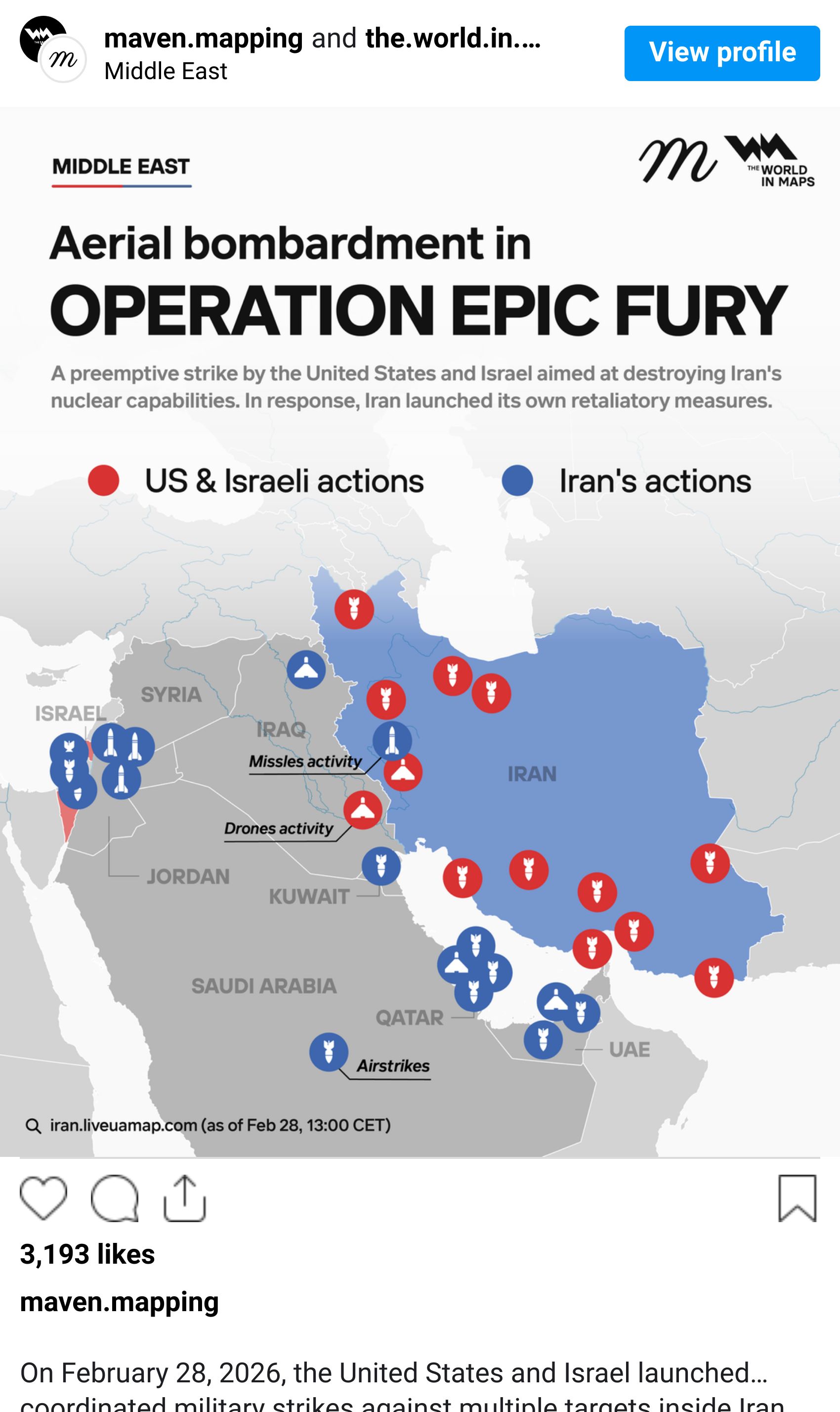
Background: On February 28, the United States and Israel launched Operation Epic Fury (US) and Operation Roaring Lion (Israel) (The Intel Brief). Operation Epic Fury was initially confirmed by President Trump during an early morning address on February 28, with US objectives being to facilitate regime change by decapitation strikes, destroy Iran’s nuclear program, and destroy Iran’s ability to strike Israel with drone, missile, or naval assets (The Intel Brief, DOW). Israel’s objective with Operation Roaring Lion is to “degrade the Iranian terrorist regime and to remove existential threat to Israel over time” (The Intel Brief).

Comment: When Operation Epic Fury is considered with a wider geopolitical context, we can clearly see the risks of other state and non-state actors getting involved. For example, Russia and China are likely to support Iran with economic support, military and dual-use equipment, and intelligence. Specifically, Russia and China are likely to provide Iran with intelligence on ongoing or planned US and Israeli operations to support Iran’s offensive and defensive military response. Russia and China are interested in guaranteeing returns on their strategic cooperation agreements with Tehran, such as oil trade, constructing economic corridors, etc. With this in mind, we get a better insight into the US strategy, and an idea of how long operations may continue. The US strategy seems to be to dismantle the growing alliance of the revisionist powers, and especially to isolate China (regime change in Iran, degrade Russia via Ukraine, and controlling Venezuela and the Southern hemisphere).
Supreme Leader Khamenei, Iranian Leaders Killed: Late on February 28, President Trump confirmed that Iranian Supreme Leader Ali Khamenei was killed (The White House, Newsmax). President Trump also stated that the strike that killed Khamenei also killed other Iranian leadership (The White House). It is uncertain which specific strike package killed Khamenei and senior Iranian leaders, but other sources confirm that “several senior commanders of the Revolutionary Guards and political officials were killed” (Iran International). On March 1, Trump stated that 48 Iranian leaders had been killed in US and Israeli strikes, including leaders the US viewed as potential candidates to replace Khamenei (Reuters). On Sunday, March 1, Iran convened a council (made of President Pezeshkian, the head of the Judiciary, and a senior cleric) to select a new Supreme Leader (CNN). Reportedly, Ayatollah Alireza Arafi is acting as interim Supreme Leader (Fox News, Newsweek).

Comment: While the special council is required by Iranian law to pick a new Supreme Leader as quickly as possible, it is uncertain if the council will make a pick. It is also uncertain, even if they do pick a new Supreme Leader, if they will announce the choice (as to protect him and preserve the new office). Remember, the Supreme Leader is the political and faith leader of Iran, so having a top-down authority is required for Tehran to make coordinated, rapid decisions, even regarding military affairs.
Controversy: Various politicians and media outlets have questions the US’s war goals, as well as the legality of Trump’s deicison to strike Iran, as US war powers lay exlucsively with US Congress. For example, popular Republican Congressman Massie (R-KY) stated his opposition to the war, calling the decision to attack Iran “not America First,” and that he will be calling for a Congressional vote (Facebook).
The New Republic styled Trump’s decision to strike Iran as Commander-in-Chief a tyrannical act, while The Cato Institute highlighted Trump’s overreach of Congress (The New Republic, The Cato Institute).
Additionally, a recent poll by CNN reports that 59% of Americans disapprove of Operation Epic Fury (CNN).
Comment: The growing opposition to Trump’s decision to launch Operation Epic Fury by the media, Congress, and the American public is likely to increase domestic political tension. American legislators may even go so far as to block further military action if a vote is called in Congress to pause the operation. It is also likely that, depending on how the narrative unfolds, the strikes on Iran will influence voters at upcoming midterm elections.
US Casualties: As of March 2, US media is reporting that six US servicemembers have died, and eighteen remain wounded as a result of actions associated with Operation Epic Fury (Marine Corps Times). On March 1, US Central Command (CENTCOM) confirmed that three American F-15E Strike Eagle aircraft were shotdown over Kuwait in a friendly fire incident (CENTCOM). CENTCOM confirms that the F-15Es were mistakenly shotdown ky Kuaiti air defenses (CENTCOM). CENTCOM confirms that “All six aircrew ejected safely, have been safely recovered, and are in stable condition” (CENTCOM).

Conflict Duration: Following the initial US and Israeli strikes which killed Supreme Leader Khamenei, killed more than 45 senior Iranian officials, destroyed at least nine Iranian navy vessels, and destroyed Iran’s air defense network, President Trump has reportedly offered “off ramps” to Tehran (Axios, DOW). Iran is reportedly interested in de-escalation via resuming negotiations, but will not give up its ability to enrich uranium (The Kobeissi Letter).
Additionally, Secretary of War Hegseth, speaking on March 2, stated that the US’s goals in Iran are to destroy Iran’s offensive missiles, its missile production, its navy and security infrastructure, and ensure Tehran never possesses a nuclear weapon (DOW). Despite stating that these objectives are not attached to a specific timeline, Hegseth stated that the operation in Iran will not be “endless” or focused on “nation-building” like in Iraq and Afghanistan (DOW).
Comment: Hegseth’s comments offer the most clarity regarding the potential length of operations in Iran. Early reporting and comments by Trump suggested that the conflict may be protracted, lasting days if not weeks. But Hegseth’s clarified goals suggest that the US may withdraw, pause, or cease operations once Iran’s defense, nuclear, and political structures are sufficiently destroyed.
However, striking hard and soft targets might be an overly idealistic approach, as another hardline, radical cleric could assume the position of Supreme Leader and rule in accordance with Khamenei’s ideology, strategy, and martyrdom (as he has been styled by Iranian state media). This would not be considered a resolution to the Iran problem, as the new regime would likely rebuild and expand its nuclear program as well as its state-sponsored terrorism. The current strategy appears to have no clear answer on how to facilitate effective regime change, and US policymakers should consider revisiting how to mobilize or cooperate with Iran’s anti-regime protestors, as well as find a way to disarm and disperse the IRGC. These are the factors, as in Afghanistan, that make a ground invasion more likely when a focused, narrow operation suddenly expands into a protracted conflict necessitating sustained military operations, funding, and nation-building components.
End Brief
That concludes this brief.
If you have questions, feel free to reach out!
Thank you for reading,
— Nick
This publication is an Open-Source Intelligence (OSINT) product and does not contain Controlled Unclassified Information (CUI) or Classified Information.
Comments represent the analysis, opinions, and estimates of The Intel Brief writer(s).