In partnership with


Curated foreign policy and national security news for professionals.
Good morning,
The following brief is a special report. This information summary (INFOSUM) is intended to provide you with relevant information on the ongoing US-Israeli operation in Iran.
This is not a comprehensive report as operations are ongoing.
Reporting Period: Up to February 28, 2026
Bottom-Line Up Front:
On February 28, the United States and Israel launched a joint operation against Iran. The ongoing operation has included air and naval strikes on Iranian military, infrastructure, and diplomatic targets. Iran has retaliated by striking Israel and US bases across the Middle East. There are no substantiated reports of US casualties, the status of Iran’s nuclear facilities, its current military capability, or the status of Iran’s military and political leadership.
Expect US Congress to convene.
US, Israel Launch Military Operation Against Iran
Summary
On February 28, the United States and Israel launched a joint operation against Iran. The ongoing operation has included air and naval strikes on Iranian military, infrastructure, and diplomatic targets. Iran has retaliated by striking Israel and US bases across the Middle East. There are no substantiated reports of US casualties, the status of Iran’s nuclear facilities, its current military capability, or the status of Iran’s military and political leadership.
Findings and Analysis
Background: On June 22, 2025, the United States launched Operation Midnight Hammer, a large-scale strike on Iran’s nuclear facilities by US air, naval, and space forces (The Intel Brief). Early battle damage assessments provided by the Trump administration claimed that Iran’s nuclear program was entirely destroyed and delayed by years (The Intel Brief). Iran retaliated with missile strikes on Al Udeid Airbase in Qatar, with all missiles being intercepted.
On June 24, a US-brokered ceasefire between Iran and Israel ends the “12-Day War.” In July, Iranian President Pezeshkian halted cooperation with the IAEA, barring inspections of Tehran’s nuclear program and its facilities (The Intel Brief, The Intel Brief).
In August, Iran agreed to conduct nuclear negotiations with the E3 (Germany, France, and the UK), but those talks fell through after the E3 triggered a UN mechanism for snapback sanctions on Iran (The Intel Brief).
On December 28, following the collapse of the Rial (Iran’s currency), large-scale protests erupted in major cities, prompting intentional internet outages, blackouts, and lethal enforcement by Iranian security forces (The Intel Brief). President Trump began to openly suggest US military intervention in January 2026.
On February 6, fearing US strikes and regime collapse, Iran and the US engaged in direct nuclear negotiations in Switzerland (The Intel Brief). By February 26, at least three known rounds of talks are concluded, but do not yield any nuclear agreement due to Tehran’s unwillingness to dismantle its nuclear program, to hand over enriched Uranium to the US, and to stop ballistic missile production (The Intel Brief).

Comment: One of the leading indicators that US strikes were imminent was the massive buildup of assets to the Middle East and Europe, including two carrier strike groups and hundreds of strike aircraft and tankers. Additionally, if you read about the progress of the nuclear talks in Switzerland, there were continued indications that progress was being made, only for Iran to reject the demands proposed by the US and envoy Steve Witkoff. This simply indicates that a genuine compromise was unlikely, and that Iran may have engaged in diplomacy to delay US intervention.
Operation Epic Fury: On February 28, US and Israeli forces launched joint strikes on Iran (The White House, US Department of War). An address by President Trump clearly establishes US objectives: prevent Iran from developing and obtaining nuclear weapons, and usher in regime change via a large-scale decapitation strike (i.e. a total termination of Iran’s senior political and military leaders, and their radical supporters or institutions) (The White House, CNN).
Reporting indicates that the Trump administration has prepared for a protracted conflict, lasting at least “several days” (CNN).

Israeli Role: The Israeli Defense Forces (IDF) stated that it has carried out strikes alongside the United States, calling the IDF’s “hundreds” of strikes in Western Iran as a part of “Operation Roaring Lion” (IDF). The IDF confirms that various strikes on Iranian surface-to-surface and air defense systems have been successful (IDF, IDF).
Israel confirms its objectives are to “thoroughly degrade the Iranian terrorist regime and to remove existential threats to Israel over time” (IDF).
Comment: We should expect battle damage assessments to be generated by US forces conducting the strike, which will likely then be sanitized to generate an update from President Trump, SECDEF, or the White House. The reason I mention that is because we may soon get confirmation about which Iranian sites have been destroyed, which senior officials are dead (as rumors suggest Khamenei was killed or severely wounded in strikes on his residence), and if US forces have sustained casualties (Visegrad 24). Once those updates are provided, we can also better determine if this operation will be short, or if a protracted conflict is emerging.
Trump’s Address: Early on February 28, President Trump published a video announcing that “massive and ongoing” US military strikes against Iran have begun (The White House, CNN). Trump noted that the Khamenei regime (citing the USS Cole Bombing, the US Embassy Hostage crisis, and the October 7 attack on Israel) cannot be allowed to develop nuclear weapons or continue uranium enrichment (The White House). Trump also urged Iranian security forces, including the Iranian Revolutionary Guard Corps, to lay down their arms, promising to grant immunity (The White House). Likewise, Trump urged Iranian citizens to shelter in place and take control

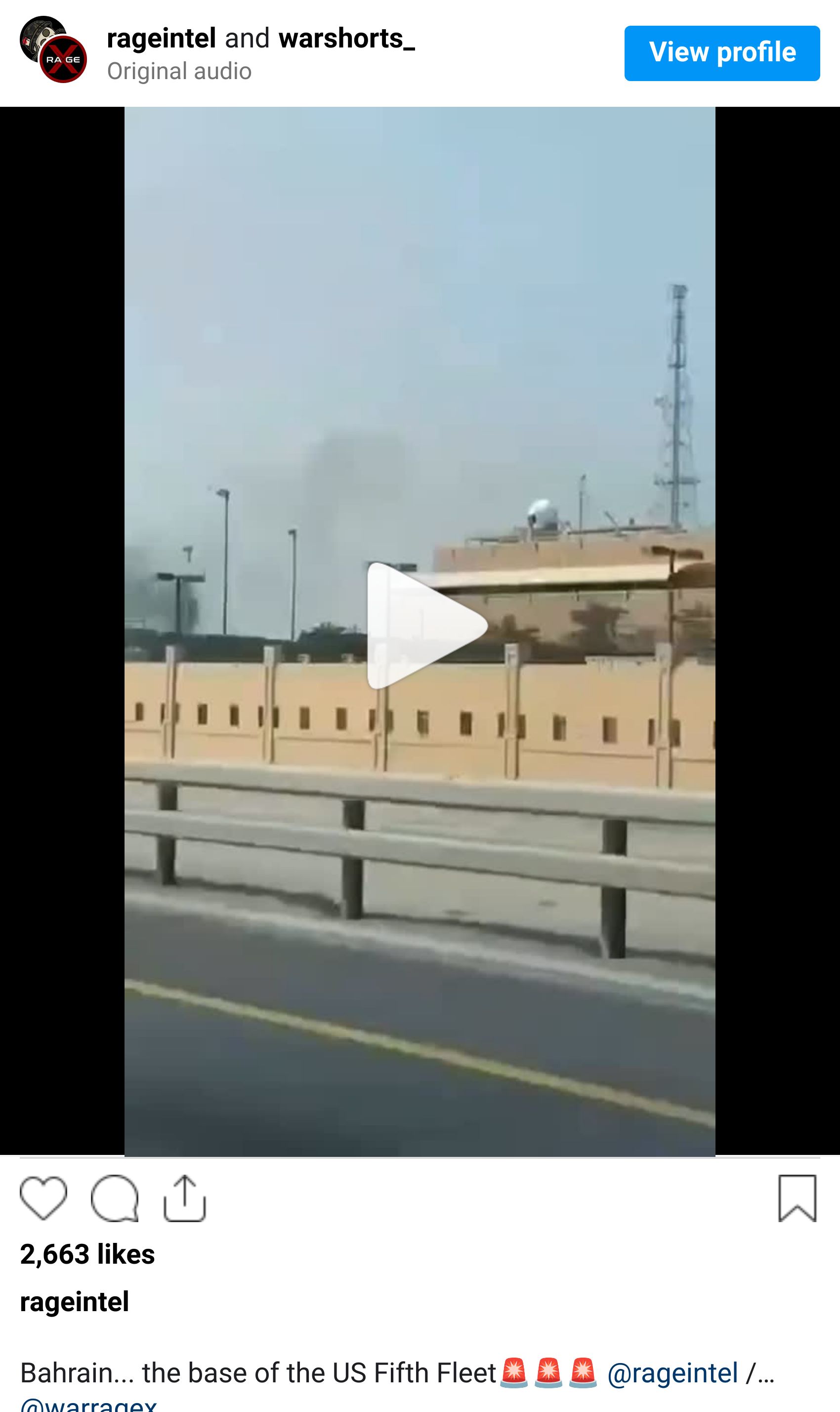
Iranian Retaliation: Iran has retaliated with strikes of its own, with the most notable being on Naval Support Activity Bahrain (NSA Bahrain), the US base which is home to US Naval Forces Central Command headquarters and the US Navy’s 5th Fleet (Stars and Stripes, CNN). OSINT reporting indicates Iranian Shahed drones have leaked through American SHORAD defenses and struck the AN/FPQ-132 early-warning radar that supports NSA Bahrain (Tessaron News, Rage Intel).
CNN reports that Iranian forces have struck targets across the Middle East, with “blasts heard” near US targets “from the beaches of Dubai to the streets of Doha” (CNN). Al Jazeera reports that Iran has struck US and Israeli targets in Israel, Bahrain, Saudi Arabia, Qatar, the UAE, and Iraq (Al Jazeera).
Comment: Saudi Arabia’s Ministry of Foreign Affairs quickly condemned Iran’s strikes, stating that “the sovereignty of the United Arab Emirates, Bahrain, Qatar, and Jordan” was violated (Roya News English). These kind of statements not only indicate where Iran has attacked US targets in the information-saturated environment, but it also suggests the shaping of third-party intervention (i.e. regional conflict).
What Will Your Retirement Look Like?

Planning for retirement raises many questions. Have you considered how much it will cost, and how you’ll generate the income you’ll need to pay for it? For many, these questions can feel overwhelming, but answering them is a crucial step forward for a comfortable future.
Start by understanding your goals, estimating your expenses and identifying potential income streams. The Definitive Guide to Retirement Income can help you navigate these essential questions. If you have $1,000,000 or more saved for retirement, download your free guide today to learn how to build a clear and effective retirement income plan. Discover ways to align your portfolio with your long-term goals, so you can reach the future you deserve.
End Brief
That concludes this brief.
I will try my best to publish Pacific Weekly tomorrow morning, as well as further briefs on Iran and a Thursday weekly update.
The normal publication schedule will resume on March 9, 2026.
— Nick
This publication is an Open-Source Intelligence (OSINT) product and does not contain Controlled Unclassified Information (CUI) or Classified Information.
Comments represent the analysis, opinions, and estimates of The Intel Brief writer(s).